
Alternatives to Yosemite Valley Rafting for Thrill Seekers
Table of Contents
- Why the Valley Float Leaves Thrill Seekers Wanting More
- Quick Comparison: Yosemite Valley Float vs. Whitewater Alternatives
- Tuolumne River Rafting Difficulty: From Class IV to Wilderness
- Cherry Creek Rafting Class V: The Ultimate Technical Challenge
- Merced River Whitewater Rafting Season: Timing the Runoff
- How to Choose Your Thrill Level: Rapids, Logistics, and Fitness
- Safety and Gear: Non-Negotiables for High-Intensity Rivers
- The Verdict: Plan Your Expedition Beyond the Valley
- Frequently Asked Questions
Last Updated: September 8, 2026
The scenic float down the Merced River through Yosemite Valley is a classic family outing, but for adrenaline-driven paddlers, it often feels like a parking lot with oars. Thrill seekers looking for alternatives to Yosemite valley rafting for thrill seekers quickly discover that the park’s iconic valley floor offers gentle currents rather than technical challenges. At Sierra Mac, we’ve spent decades guiding paddlers on the region’s most demanding rivers, and we know exactly where the real whitewater lives, just outside the park’s borders.
An interpretive study of park visitors found that thrill-seekers often pursue high-intensity recreational activities to achieve meaningful experiences within the environment, rather than settling for passive sightseeing An Interpretive Study of Yosemite National Park Visitors’ Perspectives. Below, we’ll show you exactly which rivers deliver that intensity, how to match a trip to your skill level, and what logistics separate a great expedition from a dangerous one.
Why the Valley Float Leaves Thrill Seekers Wanting More
The Yosemite Valley float is closer to a lazy river ride than a paddling expedition. The standard trip covers roughly 3 miles of gentle current, categorized as scenic and family-oriented rather than technical Yosemite.com rafting guide.
The distinction matters because it shapes expectations. Thrill seekers need continuous rapids, significant gradient, and obstacles that require active navigation. The valley offers none of that. Dedicated paddlers must look to the Merced or Tuolumne rivers for whitewater that actually tests their skills Sierra Mac River Trips river guide.
Booking a “whitewater” trip without checking the rapid classification is the most common mistake we see. A Class II float will not satisfy someone expecting Class IV action, and showing up under-equipped for a Class V canyon can put your whole crew at risk.
Quick Comparison: Yosemite Valley Float vs. Whitewater Alternatives
The table below cuts through the marketing language and compares what you actually get on the water.
| Trip Type | Typical Rapids | Gradient | Best For | Season |
|---|---|---|---|---|
| Valley scenic float | Class I-II | Gentle | Families, sightseeing | Summer |
| Merced River whitewater | Class III-IV | Moderate | First-time thrill seekers | Spring runoff |
| Tuolumne River expedition | Class IV-IV+ | Steep | Experienced paddlers | Summer |
| Cherry Creek | Class V | Extreme | Expert paddlers only | Summer |
Tuolumne River Rafting Difficulty: From Class IV to Wilderness
Tuolumne River rafting difficulty spans a genuine range, but the sections that matter to thrill seekers deliver consistent Class IV action with pushes into Class IV+ depending on water levels. This is not a river you paddle casually, it demands technical maneuvering through granite boulder fields, tight lines between holes, and constant communication with your crew.
What separates the Tuolumne from valley rafting is the wilderness context. Multi-day expeditions here involve camping in remote canyons, running multiple rapids per day, and carrying everything you need for several days on the river. Industry guides for 2026 consistently identify the Tuolumne as the primary alternative for intense whitewater near the park Sierra Mac Tuolumne expedition overview.
For paddlers progressing from Class III rivers, the Tuolumne represents a significant step up. Its gradient concentrates in specific canyon sections, creating sustained technical paddling rather than isolated difficult rapids, where river reading skills, eddy turns, and precise ferry angles become essential.
The Tuolumne rewards paddlers who have mastered the fundamentals. If you can confidently run Class III rapids and want to test your skills against continuous Class IV water, this river is your proving ground.
Cherry Creek Rafting Class V: The Ultimate Technical Challenge
Cherry Creek rafting Class V is the benchmark for commercial whitewater in the region, and it exists in a category entirely its own. This tributary of the Tuolumne packs an extraordinary concentration of difficult rapids into a short, steep canyon, with some sections approaching the limits of what commercial rafting can safely run. Sierra Mac pioneered commercial Class V rafting on Cherry Creek, and it remains the definitive test for expert paddlers.
The technical demands go far beyond physical strength. Cherry Creek requires precise boat control in high-volume water, rapid decision-making in blind canyons, and absolute trust in your guide’s reads. The gradient is relentless, and the consequences of a mistake are serious, this is expedition-grade whitewater for people who have already run the Tuolumne and want more.
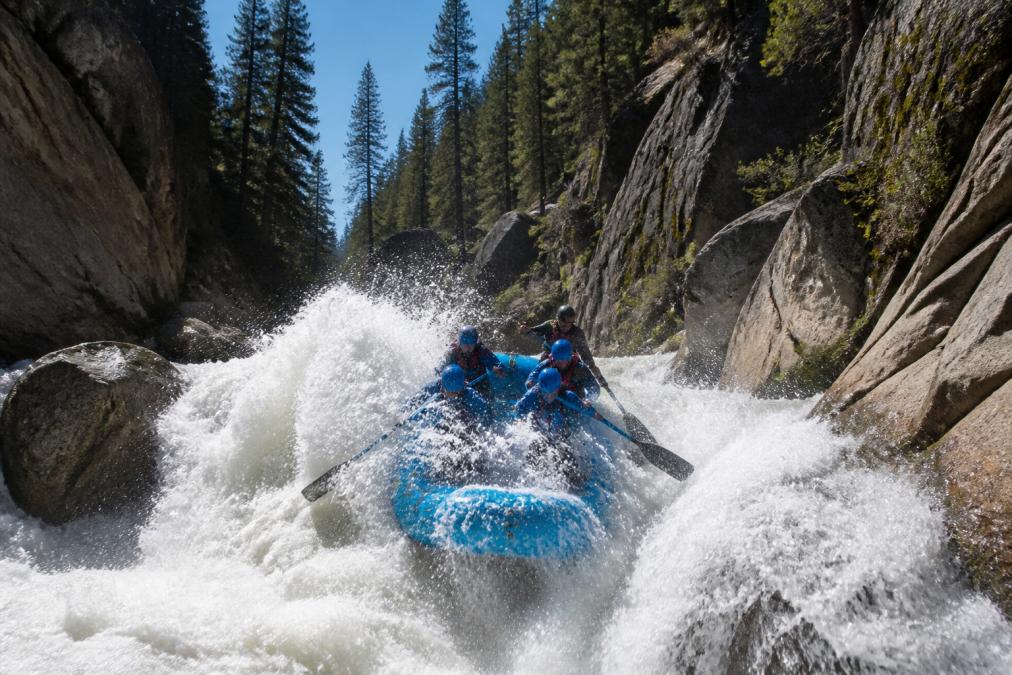
Do not book Cherry Creek as your first rafting trip. This river demands prior whitewater experience, solid swimming ability, and a comfort level with high-consequence environments. Outfitters enforce these requirements for your safety.
Merced River Whitewater Rafting Season: Timing the Runoff
The Merced River whitewater rafting season runs primarily on spring snowmelt, which means timing is everything. Unlike the dam-controlled Tuolumne, the Merced’s flows depend on the winter snowpack and spring temperatures. The window for high-intensity runs typically opens in April and extends through June, with the most challenging conditions during peak runoff.
As of May 2026, guided whitewater trips were actively running on the Merced, serving as the primary alternative to the scenic valley float Regional rafting group updates. The key variable is water level. Early season brings high, pushy water that rewards aggressive paddling. Later in the season, flows drop and the river becomes more technical at lower speeds, exposing rocks that require careful line selection.
For thrill seekers, the calculation is straightforward: book early for raw power, book late for technical precision. Either way, you need an outfitter that monitors river flow daily and adjusts trip plans accordingly.
How to Choose Your Thrill Level: Rapids, Logistics, and Fitness
Thrill seekers need a progression map that translates whitewater classifications into concrete paddling competencies. The table below helps you self-select a challenge based on what you have already run, not what you hope to run.
| Skill Benchmark | Rapids You Have Run | Required Competencies | Recommended River |
|---|---|---|---|
| Advanced Beginner | Class II-III | Reliable forward stroke, basic eddy turns, comfortable in waves up to 3 feet | Merced River (spring, lower flows) |
| Intermediate | Class III (continuous) | Aggressive eddy turns, peel-outs, reading water from the boat, bracing in holes | Merced River (peak runoff) or Tuolumne (Main) |
| Advanced | Class IV (multiple trips) | Precise ferry angles, boofing, combat rolls (if kayaking), rapid decision-making under pressure | Tuolumne River (Main) multi-day |
| Expert | Class IV+ (consistent) | Mastery of high-volume water, ability to scout and run blind rapids, high consequence tolerance | Cherry Creek (Class V) |
This progression is about building a mental library of river reads. A paddler who has only run pool-drop Class III rapids will struggle with the continuous, pushy water of the Tuolumne’s gorge section. The river does not pause between rapids, and there is no time to reset your line, your brain must process the next horizon line while your body is still executing the previous maneuver.
Fitness is the second half of this equation. The physical demand of a multi-day Class IV expedition is closer to backcountry skiing than to a gym workout, you paddle 4-6 hours a day in cold water, often at altitude, and cumulative fatigue breaks paddlers by day two. The muscle groups that matter are your lats, core, and grip strength. Training with paddling-specific exercises, such as heavy cable rows, anti-rotation holds, and farmer’s carries, builds endurance that translates to the raft.
Logistics are the final filter. A day trip on the Merced requires a shuttle and a few hours. A Tuolumne expedition requires wilderness permits, camping gear, dry bags, and a willingness to be unreachable for days. Cherry Creek adds a helicopter evacuation plan and a mandatory guide who knows the canyon’s idiosyncrasies. If you are not prepared for the logistics, you are not prepared for the river. Lake Tahoe water activities.
Use the skill benchmark table to be honest with yourself. The river will not care about your gym PRs or your kayaking certification. It will only care about your ability to execute the next move correctly.
For paddlers building toward the Tuolumne or Cherry Creek, the Merced during high water is the ideal training ground. It offers Class III-IV rapids with enough volume to teach you how to handle pushy water, but with easier access and shorter trip lengths. Run the Merced until the rapids feel routine, then graduate to the wilderness, this progression builds confidence without building complacency.
Safety and Gear: Non-Negotiables for High-Intensity Rivers
Safety on Class IV and V rivers is not a checklist; it is a system. The gear list below addresses the specific demands of multi-day wilderness expeditions where a rescue is hours away, not minutes.
Personal Flotation Device (PFD): A properly fitted Type III or Type V PFD is non-negotiable. For high-intensity rivers, look for a PFD with a rescue harness attachment point, multiple adjustment points to prevent ride-up, and ample pocket space for a knife and whistle. The fit should be snug enough that a guide can grab the shoulder straps and lift you without the PFD moving over your head.
Helmet: A whitewater-specific helmet must have a solid shell that can withstand impact with rock, a low-profile design that does not snag on overhanging branches, and a secure chin strap. Look for helmets certified to ASTM F1492 or UIAA 106 standards. In tight granite canyons like Cherry Creek, a helmet with a visor or full-face protection is often recommended due to the high risk of backward falls into rocks.
Thermal Protection: River temperatures in these canyons hover near 50 degrees Fahrenheit even in July. Cold water shock can cause involuntary gasping and loss of motor control within seconds of immersion. A 3/2mm wetsuit is the minimum for a day trip; a 5/4mm wetsuit or a drysuit is recommended for multi-day expeditions where you cannot quickly change into warm clothes. Neoprene booties are essential for protecting your feet when walking on sharp granite.
Rescue Gear: For self-guided trips, you need more than a throw bag. A complete rescue kit includes a throw bag with at least 70 feet of rope, a locking carabiner, a pulley for mechanical advantage systems, a knife that can be accessed with one hand, and a signaling device (whistle or air horn). For multi-day trips, add a satellite messenger or personal locator beacon. Cell service is non-existent in these canyons, and a rescue call requires a satellite connection.
The Guide Factor: On commercial trips, the guide is your primary safety system. Professional river guides hold certifications in swiftwater rescue (such as Swiftwater Rescue Technician) and wilderness first aid. But the real difference is local knowledge. A guide who has run the Tuolumne 100 times knows where hidden holes form at 2,000 cubic feet per second versus 4,000 cfs, and which eddies are safe at high water and which lines become suicide at low water. Ask your outfitter about the average tenure of their guides on the specific river you are booking, a guide with 10+ years on one river is worth more than a guide with 5 years on five different rivers.
On a Class V river like Cherry Creek, the margin for error is measured in inches. A missed line can pin a raft against a boulder, creating a situation that requires a complex mechanical advantage system to extricate. This is not a place to learn rescue skills; it is a place to apply them flawlessly.
For multi-day trips, the safety calculus shifts. You are not just managing the rapids; you are managing the camp, the food, and the group’s physical state. Hypothermia is a real risk without a dry change of clothes and a way to warm up quickly after a swim. Dehydration is common because paddlers forget to drink enough in the cool canyon air. And fatigue is cumulative, so the guide must monitor the group’s energy levels and adjust the paddling pace accordingly. The best safety gear is a well-rested, well-fed, and well-informed crew.
The Verdict: Plan Your Expedition Beyond the Valley
If you are a thrill seeker, the valley float is not your river. The alternatives to Yosemite valley rafting for thrill seekers are clear: the Merced for spring runoff power, the Tuolumne for sustained Class IV wilderness expeditions, and Cherry Creek for the ultimate Class V test. Each step up the scale demands more skill, more fitness, and more respect for the river.
The shift toward regional river systems for high-intensity whitewater reflects a broader trend in adventure travel, where paddlers seek out technically demanding runs rather than crowded scenic floats KQED coverage of Yosemite alternatives. Sierra Mac has guided these rivers since 1965, and we built our reputation on the Tuolumne and Cherry Creek long before they appeared on industry radar. Our guides know every rapid, every eddy, and every safe line at every water level.
The challenge is matching your ambition to the right river, then trusting a team that has run these canyons for generations. Get started with Sierra Mac and book the expedition that will actually test your skills.
Frequently Asked Questions
Can you whitewater raft in Yosemite National Park?
The rafting inside Yosemite Valley on the Merced River is a scenic float, not a whitewater experience. For actual rapids, you must leave the Valley floor. Guided trips run on the Merced River outside the park boundary and on the Tuolumne River, which offers Class IV and V whitewater within a short drive of the park’s northwest entrance.
What are the most challenging whitewater rivers near Yosemite?
The Tuolumne River and its tributary, Cherry Creek, are the most challenging whitewater rivers near Yosemite. Cherry Creek features steep, continuous Class V rapids that demand expert paddling. The main Tuolumne offers a mix of Class IV and V rapids, making it a premier destination for experienced thrill seekers looking for technical wilderness runs.
How does Merced River rafting compare to other regional whitewater?
The Merced River near Yosemite offers a middle ground. Its whitewater rafting season typically runs from spring into early summer, driven by snowmelt, and provides Class III and IV rapids that are technical but more forgiving than the Tuolumne. It is an excellent step up from the valley float, while the Tuolumne and Cherry Creek represent a significant jump in difficulty.
What time of year offers the best whitewater conditions for thrill seekers?
The best whitewater conditions depend on the river’s seasonal flow. The Merced River’s whitewater rafting season peaks during spring runoff, usually from April through June. The Tuolumne River typically has its highest flows from May through July, offering sustained Class IV and V rapids. Always check current water levels with your outfitter, as seasonal snowpack dictates the exact timing and intensity.
What safety certifications should I look for in a whitewater rafting outfitter?
An established outfitter with decades of experience on these specific rivers is a strong indicator of safety standards.