
How to Choose a Yosemite Rafting Outfitter: 2026 Guide
Table of Contents
- Quick Comparison: Park Float Trips vs. Professional Outfitters
- Key Factors When Choosing a Yosemite Rafting Outfitter
- Merced River Rafting Difficulty Levels Explained
- Best Time of Year for Tuolumne River Rafting
- What to Pack for a Whitewater Rafting Trip
- What Competitors Miss: Accessibility, Stewardship, and Cancellation Policies
- Conclusion
- Frequently Asked Questions
Last Updated: September 12, 2026
Quick Comparison: Park Float Trips vs. Professional Outfitters
The fastest way to choose a Yosemite rafting outfitter is to decide which river experience you actually want, because the park’s own float trips and commercially guided whitewater trips are two different products. Inside Yosemite Valley, rafting is a calm float on the Merced River: rentals run about $36 per person, paddlers must be at least 5 feet tall, and participants must weigh over 50 pounds, per Travel Yosemite’s rafting rental requirements. The 2026 season is benefiting from steady flows and solid reservoir levels, according to All-Outdoors’ 2026 California season update, which means both options should run longer than in a dry year.
If you want rapids, Class III-IV water, and a river guide steering the boat, you book a permitted commercial outfitter outside the park boundary. Half-day Merced River trips with a professional company run roughly $100 per person, based on Tripadvisor’s Yosemite rafting forum pricing. Sierra Mac has guided trips on the Merced and Tuolumne since 1965, so we’ll frame the rest of this guide around the decision you’re actually making: float or whitewater, self-guided or guided.
| Factor | Park Float Trip | Professional Outfitter |
|---|---|---|
| Water type | Flat, Class I | Class II-V rapids |
| Cost | ~$36 per person | ~$100+ per person, half day |
| Guide | None, self-guided | Licensed river guide |
| Requirements | 5 ft tall, 50+ lbs | Varies by trip and river |
| Season | Often closes mid-season | Runs with reservoir-fed flows |
The single biggest mistake first-time visitors make is booking a “Yosemite rafting trip” without checking which river and which operator. The park float and an outfitter-led whitewater run are not substitutes for each other.
Key Factors When Choosing a Yosemite Rafting Outfitter
Five factors decide whether your trip is safe, fun, and worth the money: permits and licensing, guide qualifications, group size, trip duration, and how the operator handles logistics. Get those right and almost everything else sorts itself out.
Permits, Licensing, and Guide Qualifications
A permitted outfitter holds specific authorization for the river it runs, whether that’s a national forest permit for the Tuolumne or a park authorization for the Merced. Ask directly which permit covers your trip. Commercial guides also carry advanced medical and swiftwater rescue training, according to Triad River Tours’ guide training overview, which is the practical difference between a guided run and a rental raft.
Group Size, Trip Duration, and Logistics
Smaller groups mean more attention from your guide and less time waiting at the launch site. Trip length ranges from a half day to multi-day expeditions, and duration should match your group’s stamina, not just your budget. On logistics, confirm who handles the shuttle to the put-in and back from the take-out point before you pay a deposit.
Ask two questions before booking: “Which permit covers this river?” and “Who drives the shuttle?” An outfitter who answers both without hesitation usually runs a tight operation.
Merced River Rafting Difficulty Levels Explained
Merced River rafting difficulty levels range from flat Class I water inside Yosemite Valley to Class IV rapids on the commercial stretch outside the park. The park float is the gentlest option and suits families with young children. The guided Merced run steps up to Class III-IV, where you’ll paddle on command and the guide reads the river for you.
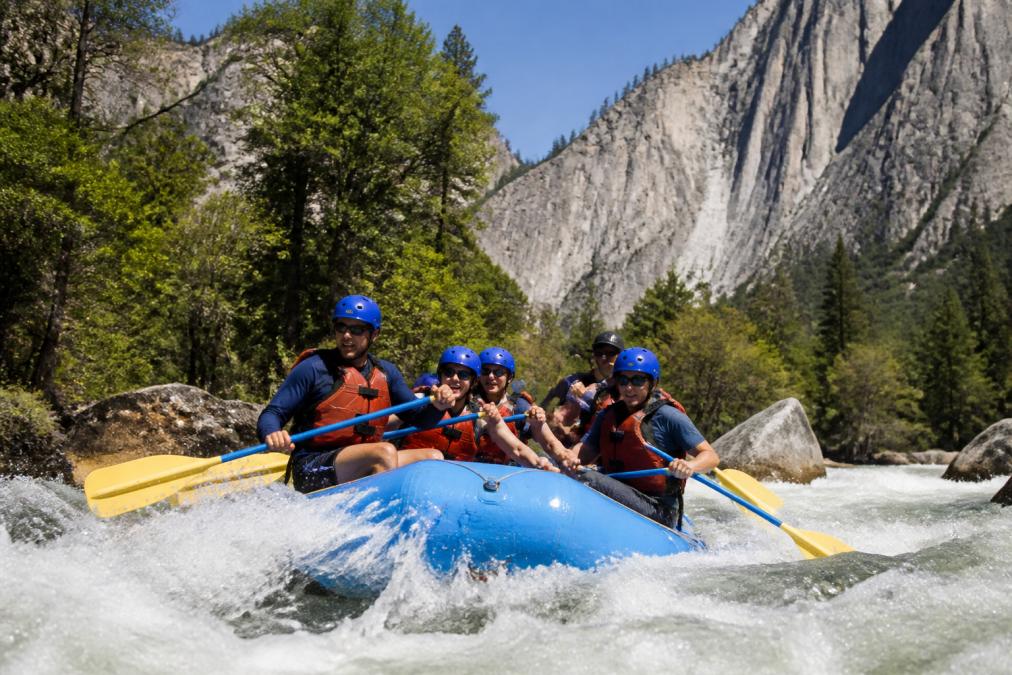
River classification isn’t marketing language. Class I is moving flat water; Class IV means big, technical rapids that demand a guide who knows the specific line. That’s why a permitted outfitter matters more than a cheaper rental once you move past Class II.
Here’s how the scale translates into an actual day on the water, so you can match a class to your group instead of guessing:
| Class | What the water does | What you do | Who it suits |
|---|---|---|---|
| I | Smooth current, small riffles, no obstacles | Sit back, paddle occasionally, swim if you want | Families with young kids, first-timers, non-swimmers in a PFD |
| II | Clear channels, easy waves, occasional rock to dodge | Light paddling, follow the guide’s simple calls | Beginners, older adults, groups mixing skill levels |
| III | Moderate waves, tight maneuvering, splashy drops | Active paddling on command, brace through waves | Teens and adults in reasonable health, repeat rafters |
| IV | Big, technical rapids with precise entry lines | Hard paddling, quick reactions, self-rescue readiness | Confident paddlers, strong swimmers, guided-only water |
A few mechanics worth knowing before you pick a class:
- Class ratings shift with flow. The same rapid can run a full class harder at high water in late spring than at late-summer flows. Ask the outfitter what class your trip is running at on your date, not what the brochure says in general.
- Class is per-rapid, not per-river. A trip can be mostly Class II with one Class IV drop. Ask how many named rapids you’ll hit and at what class, not just the trip’s headline rating.
- Swimming ability matters more as class rises. On Class III-IV water, most operators expect you to be comfortable in moving water and able to follow commands under splash. If anyone in your group can’t swim, stay at Class I-II.
- Age and weight minimums tighten with class. The park float’s 5-foot height and 50-pound minimum are the floor; guided Class III-IV trips typically set their own higher age and fitness thresholds, so confirm per trip.
Ask the outfitter: “What class is this stretch running at today’s flow, and how many Class III or higher rapids will we hit?” A vague answer usually means the trip is milder than the marketing implies.
If your group spans abilities, the honest move is to book the lowest common denominator, a Class II trip that keeps everyone in the boat beats a Class IV trip where half the group is terrified and the other half is bored.
Best Time of Year for Tuolumne River Rafting
The best time of year for Tuolumne River rafting is late spring through summer, when snowmelt and reservoir releases keep the river at runnable flows. The 2026 season is projected to run long thanks to solid reservoir levels, per the 2026 California whitewater season update. Flows peak earlier in heavy snow years and hold steadier when reservoirs buffer the release.
Two variables decide your date: time of year and the outfitter’s reputation, based on BR Expeditions’ Tuolumne outfitter guide. Book early for peak-season weekends, and expect the shoulder season to offer fewer crowds at similar water levels.
What most booking pages don’t tell you is that your date is provisional until the water cooperates. Tuolumne flows are managed, and releases can be cut, held, or pushed higher on short notice. That means the real question isn’t just when to go, it’s what happens to your money and your plans if the river doesn’t cooperate.
How flow decides whether your trip runs
- Too high: At very high releases, outfitters may cancel or downgrade a trip for safety. Big water isn’t a thrill upgrade, it’s a liability call the operator makes, sometimes the morning of.
- Too low: Late in a dry season, sections can drop below runnable levels. Some operators switch to a shorter stretch or a different river rather than cancel outright.
- Just right: The sweet spot is a steady, moderate release, enough push for real rapids, not so much that the trip gets pulled.
Questions to ask before you pay a deposit
- What is your cancellation and rescheduling policy if flows are too high or too low?
- Do you refund, reschedule, or substitute a different river or stretch?
- How much notice do you give if you cancel, same day, or the night before?
- If I reschedule, is there a fee or a blackout window?
- If I cancel for my own reasons, what’s the cutoff and the penalty?
Get the answers in writing. Policies differ sharply between operators, and “weather-dependent” can mean anything from a full refund to a credit you can only use that season.
A deposit is not a guarantee your date runs. Before you book flights or lodging around a rafting date, confirm the operator’s flow-cancellation terms and build in a flexible buffer day if your schedule allows.
Practical timing takeaways
- Peak season (late spring-mid summer): Best odds of strong flows, but the highest demand and the least flexibility if a date gets pulled.
- Shoulder season: Fewer crowds and often similar water, but a higher chance of low-flow adjustments late in the year.
- Book early, stay flexible: Reserve peak weekends well ahead, but keep your travel plans loose enough to absorb a reschedule.
Treat your rafting date as weather- and flow-dependent from the start. The outfitter who explains their cancellation policy clearly before you ask is usually the one who handles a reschedule well when it happens.
What to Pack for a Whitewater Rafting Trip
Pack for a whitewater rafting trip as if you’ll be wet for hours: quick-dry layers, secure footwear, and a dry bag for anything that must stay dry. Most permitted outfitters supply the personal flotation device, helmet, and paddle, but you supply the layers underneath.
- Synthetic or wool base layer, never cotton
- Secure sandals or water shoes that won’t slip off
- Sunscreen and a strap for glasses or sunglasses
- A dry bag for phone, keys, and a change of clothes
- A wetsuit if water temperatures run cold, which many operators rent
Cotton kills on a river trip. It holds water, drains heat, and leaves you shivering even on a warm day. Wear synthetic or wool instead.
What Competitors Miss: Accessibility, Stewardship, and Cancellation Policies
Accessibility varies by river and operator, so call ahead and describe your group’s needs rather than assuming. On stewardship, follow Leave No Trace principles: pack out everything, stay on established paths at launch and take-out points, and never leave food scraps at riverside stops. For cancellations, get the policy in writing. Weather-dependent trips may be rescheduled or refunded at the operator’s discretion, and the terms differ between companies.
Accessibility varies by river and operator, so call ahead and describe your group’s needs rather than assuming. On stewardship, follow Leave No Trace principles: pack out everything, stay on established paths at launch and take-out points, and never leave food scraps at riverside stops. For cancellations, get the policy in writing. Weather-dependent trips may be rescheduled or refunded at the operator’s discretion, and the terms differ between companies.
Families with kids 12 and up who want a real river experience without a full expedition commitment, and groups who value a guide who knows the specific line on the specific river.
Conclusion
Choosing between a flat park float and a guided whitewater run comes down to what your group actually wants from the day. Sierra Mac has run trips on the Merced, Tuolumne, and Cherry Creek since 1965, with professional local guides, a location 15 miles from the park’s northwest entrance, and options from mild half-day floats to multi-day Class V expeditions. If you want expert guidance and access to genuinely varied water, book with Sierra Mac and let the guides handle the river.
Frequently Asked Questions
What should I look for in a professional Yosemite rafting outfitter?
Check three things: permits for the specific river you want to run, guide certifications in swiftwater rescue and first aid, and a clear safety record. Outfitters on the Merced near Yosemite vary in pricing for a half-day trip. Ask whether the company holds the required Stanislaus National Forest or Merced River authorizations, and confirm guide-to-guest ratios before you book.
Do I need experience to go whitewater rafting near Yosemite?
No prior experience is required for most guided trips. Commercial outfitters manage guests with little to no rafting background, and guides provide paddling instruction before launch. That said, Class IV and V sections on Cherry Creek demand a higher fitness level and comfort in the water. Families with kids aged 12 and up fit well on Class II-III stretches, while thrill-seekers can step up to more intense runs with the same outfitter.
What is the difference between rafting inside the park and whitewater rafting outside it?
Rafting inside Yosemite Valley is a calm float trip on flat water, with rentals around $36 per person and a 50-pound minimum weight plus a 5-foot height requirement for paddlers, per Travel Yosemite (2026). Whitewater rafting happens outside park boundaries on rivers like the Merced and Tuolumne, where Class III-V rapids and professional guides define the experience. If you want rapids, you need a permitted commercial outfitter, not a park rental.
How far in advance should I book a rafting trip near Yosemite?
Book at least four to six weeks ahead for peak summer weekends, and earlier for multi-day Tuolumne trips or Cherry Creek expeditions, which have limited launch dates. The season is projected to run long with steady flows from solid reservoir levels, so shoulder-season dates in May and September offer better availability. Weekday departures are easier to secure on short notice.