
Tuolumne Rafting Trip Duration: One-Day vs Multi-Day Itineraries
Last Updated: November 22, 2026
Quick Summary
A Tuolumne rafting trip ranges from a half-day to three days, with one-day trips maximizing time in the rapids and multi-day trips trading paddling hours for camping and canyon solitude. A three-day expedition involves roughly 10 to 12 hours of paddling total, so it is not the most rafting option.
- A one-day trip keeps you paddling most of the day, with 4 to 6 hours on the water.
- The three-day trip is the most immersive option, not the one with the most whitewater.
- Day two of a three-day expedition is light on rafting, with a side hike and shorter paddling block.
- Water flow is the biggest variable, since spring runoff can reroute or shorten a stretch.
- Plan 30 to 45 minutes for check-in and gear-up before your trip launches.
Table of Contents
- How Long a Tuolumne Rafting Trip Actually Takes
- One-Day vs. Multi-Day Tuolumne Rafting: Side-by-Side Comparison
- A Realistic Door-to-Door Timeline for Your Rafting Day
- Tuolumne River One-Day Rafting Itinerary, Hour by Hour
- Inside the Tuolumne River 3-Day Rafting Trip
- Reading the Tuolumne River Rafting Map: Put-In, Take-Out, and Mileage
- Tuolumne River Rapid Classes and What They Mean for Trip Length
- How Water Flow, Weather, and Conditions Reshape the Itinerary
- Frequently Asked Questions
How Long a Tuolumne Rafting Trip Actually Takes
A Tuolumne rafting trip runs from a single day on the water to three days in a remote canyon, and the difference between them is bigger than most people expect. First-timers often book the longest option assuming more days means more whitewater. It usually doesn’t work that way.
Here’s the honest math. A one-day trip puts you on the river for several hours of near-continuous paddling. A three-day expedition covers more miles, but a good share of that time goes to camp setup, side hikes, and meals rather than rapids. As Sierra Mac’s cost breakdown of a three-day expedition describes it, a three-day trip involves roughly 10 to 12 hours of paddling spread across the whole outing, alongside hiking, camping, and eating.
The right trip length depends on what you want your days to feel like, not how many river miles you can tick off.
On-Water Time vs. Total Trip Time
On-water time is the hours your raft is actually moving through current. Total trip time includes check-in, the safety briefing, shuttle transport to the put-in, lunch stops, and the return journey.
For a day trip, expect the two figures to sit fairly close together. For a multi-day trip, they diverge sharply. Camp chores, swimming holes, side streams, and long evenings at camp all count toward total trip time but add zero river miles.
Watch out: booking a three-day trip expecting three full days of paddling is the most common mismatch we see. One Tripadvisor reviewer advises against the three-day option for exactly this reason, noting that the second and third days involve little rafting and long stretches at camp, though the side hikes were enjoyable. Treat that as one guest’s experience rather than a rule, but it’s a fair warning about expectations.
One-Day vs. Multi-Day Tuolumne Rafting: Side-by-Side Comparison
The fastest way to choose is to compare what each trip length actually delivers. A one-day trip maximizes time in the rapids. A multi-day trip trades paddling hours for solitude, camping, and access to parts of the canyon day trippers never reach.
| Trip Length | Time on Water | Overnight | Best For | Pace |
|---|---|---|---|---|
| Half-day | A few hours | No | Families with younger kids, first-timers | Gentle |
| One-day | Most of the day paddling | No | Travelers with one free day near Yosemite | Steady |
| Two-day | One full day plus a partial day | Yes, one night | Groups wanting camping without a long commitment | Moderate |
| Three-day | Roughly 10-12 paddling hours total | Yes, two nights | Groups prioritizing canyon remoteness and camp life | Relaxed on water |
Two things stand out: the three-day trip is not the “most rafting” option, it’s the most immersive one, and the half-day and one-day trips are the only choices that keep you moving most of your time on the river.
If you’re weighing the actual departures and want to see how the 1-, 2-, and 3-day options line up against your dates, you can compare the Tuolumne River rafting trips and pick the one that fits your schedule.
A Realistic Door-to-Door Timeline for Your Rafting Day
A launch time alone does not show the full door-to-door window, which is what actually shapes your day. Plan for the non-paddling time around check-in, briefing, and shuttles.
The timeline below shows a general one-day sequence. Exact clock times shift with water flow, group size, and which stretch you run, so confirm your schedule with Sierra Mac.
| Phase | Typical Window | What Happens |
|---|---|---|
| Drive to meeting point | 30-90 minutes | Mountain roads; allow buffer for traffic and gravel |
| Check-in and gear-up | 30-45 minutes | Waivers, helmet and life-vest fitting, dry-bag packing |
| Safety briefing | 15-30 minutes | Paddle commands, swim protocol, river reading |
| Shuttle to put-in | 30-60 minutes | Often includes a rough four-wheel-drive road |
| On-water paddling | 4-6 hours | Includes lunch stop and swimming-hole breaks |
| Take-out and load | 30-45 minutes | Rafts deflated and loaded, gear collected |
| Shuttle back | 30-60 minutes | Return to the meeting point |
| Drive home | 30-90 minutes | Usually the quietest part of the day |
For multi-day trips the door-to-door math changes shape. Day one still includes the full check-in, briefing, and shuttle block, but the return shuttle only happens on the final day. Middle days start and end at camp, so non-paddling time is absorbed into camp life rather than tacked onto a single long day.
If you are weighing departures and want to see how the 1-, 2-, and 3-day options line up against your dates, you can compare the Tuolumne River rafting trips and pick the one that fits your schedule.
Tuolumne River One-Day Rafting Itinerary, Hour by Hour
A one-day Tuolumne River rafting itinerary follows a predictable rhythm: morning briefing, a long middle block of continuous whitewater, a lunch stop, and an afternoon push to the take-out.
7:30-8:30 a.m., Arrival and check-in. Paperwork, waivers, and gear fitting happen while guides rig the rafts.
8:30-9:00 a.m., Safety briefing. Paddle commands, what to do if you swim, how the guide reads the river, and a walk-through of the day’s biggest rapids.
9:00-10:00 a.m., Shuttle to the put-in. On the Main Tuolumne this can involve a rough four-wheel-drive road, which is why the shuttle is built into every trip rather than treated as optional logistics.
10:00-10:30 a.m., Launch and warm-up. The first stretch dials in paddle timing before the bigger rapids arrive. Groups that find their rhythm early tend to move faster all day.
10:30 a.m.-12:30 p.m., Morning whitewater block. This is the most continuous paddling of the day, mixing boulder gardens with longer rapids. Guides stop to scout or brief the biggest drops.
12:30-1:30 p.m., Riverside lunch. Guides typically stop on a shaded bank or gravel bar. Many trips build in a swimming hole or side-stream visit here when conditions allow.
1:30-3:30 p.m., Afternoon push. Groups have found their rhythm, the guide knows how the crew responds to commands, and the pace picks up.
3:30-4:30 p.m., Take-out and load. Rafts are deflated and loaded, gear is collected, and the shuttle back to the meeting point begins.
4:30-5:30 p.m., Return shuttle and drive home. You finish tired in the good way, with just enough energy left to eat.
Two things drive how far that schedule slips. Water flow is the biggest: spring runoff can shorten a stretch or reroute around a section, while lower late-season flows can stretch the same miles into more paddling time. Group pace is the second: a crew that rigs quickly and paddles in sync finishes earlier than a large group with several first-timers.
If you want to know exactly what gets served on the water, the fresh meals served on the river page walks through the menu approach.
Inside the Tuolumne River 3-Day Rafting Trip
A three-day Tuolumne trip is a multi-day format. Confirm which overnight and camp arrangements are included before you book.
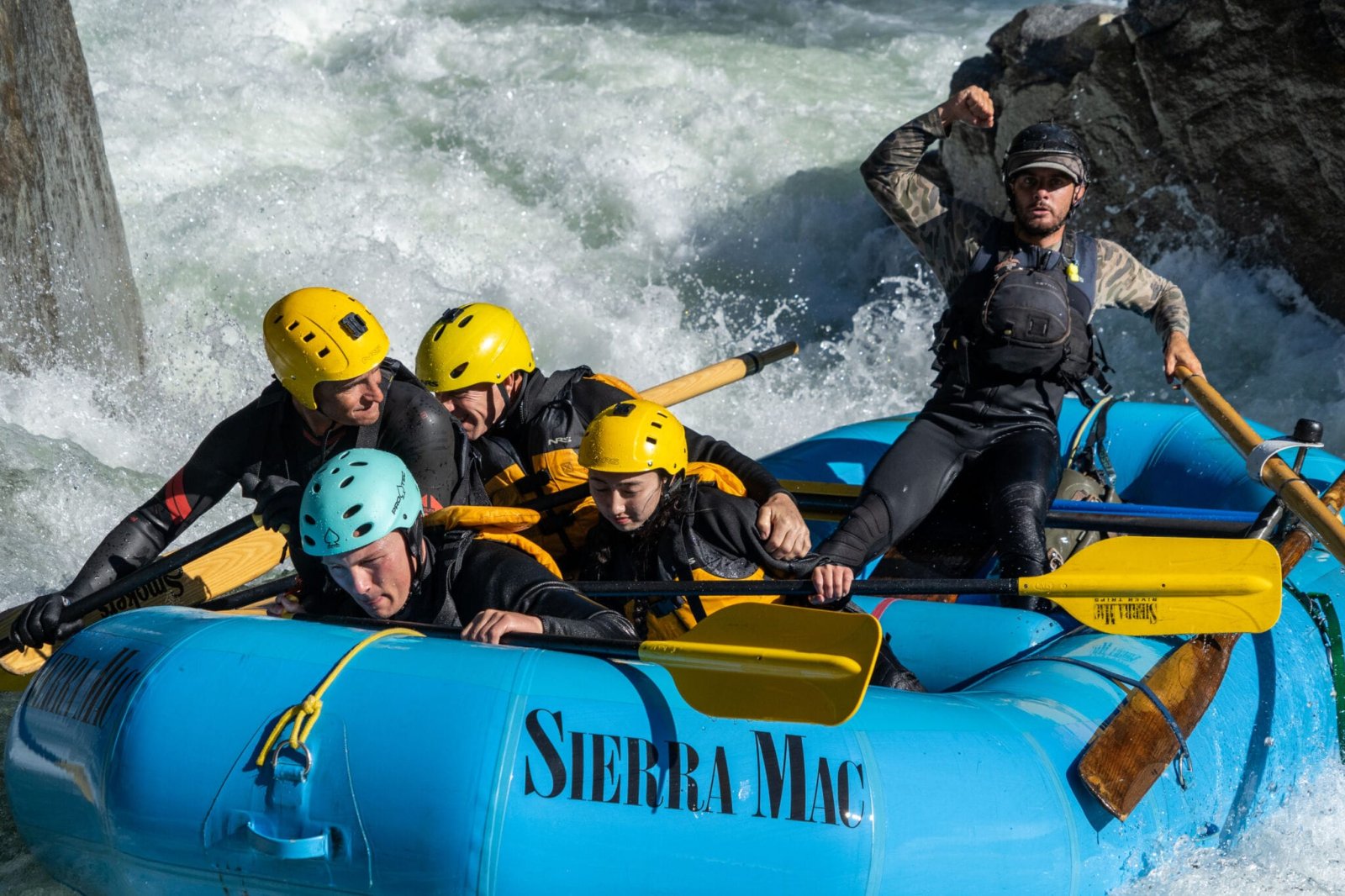
Meals are a genuine part of the experience rather than an afterthought. A day of paddling builds a serious appetite, and outfitters who run multi-day trips learn to cook accordingly, as Sierra Mac’s river meal planning explains. If you’re wondering where you’ll sleep the night before or after your trip, the Tuolumne River campground guide covers the options near the put-in and take-out.
Day-by-Day Breakdown of a Three-Day Expedition
- Day one: check-in, briefing, shuttle to the put-in, and a full afternoon of paddling to camp. Guides set up camp while guests settle in; dinner is cooked riverside.
- Day two: a slower start, a side hike or layover activity, and a shorter paddling block. This is the day the Tripadvisor reviewer flagged as light on rafting, so come for the canyon, not the whitewater.
- Day three: an early break of camp, the final stretch of river to the take-out, and the shuttle back.
If you want to know exactly what gets served on the water, the fresh meals served on the river page walks through the menu approach.
Reading the Tuolumne River Rafting Map: Put-In, Take-Out, and Mileage
The Tuolumne River rafting map is simpler than it looks once you know the anchors.
Tuolumne River Rapid Classes and What They Mean for Trip Length
Rapid classes range from Class IV to Class V, and the class of rapid on your route tells you more about trip difficulty than trip length does.
Class IV rapids mean big, technical moves with consequences for a missed line. Class V means sustained, powerful whitewater where the guide’s judgment matters most. The Main Tuolumne mixes boulder gardens with continuous stretches, which is why guides brief each rapid before you run it. For a deeper breakdown, the Tuolumne River rapid classes guide explains the grading in detail.
How Water Flow, Weather, and Conditions Reshape the Itinerary
Water flow is the single biggest variable in any Tuolumne rafting itinerary. Spring runoff swells the river, sometimes pushing flows high enough to change which sections run and how long each leg takes. Later in the season, lower flows can slow the pace and shift the schedule.
That’s why we never promise a rigid hour-by-hour plan. A high-water day may shorten a stretch or reroute around a section; a low-water day may stretch the same miles into more paddling time. The high-water rafting guide explains how spring flows on the Merced and Main Tuolumne change the timing and shape of a trip.
Weather adds its own layer. Afternoon storms, heat, and wind all affect how guides pace the day. The best preparation is flexibility: book your dates, then trust the guide’s read of the river on the morning of your trip.
Choosing a Tuolumne rafting trip comes down to matching the itinerary to the day you actually want, whether that’s maximum time in the rapids or a slow evening at camp in a remote canyon. Sierra Mac is a family-owned outfitter founded in 1965, offering trips ranging from mild half-day floats to intense Class V expeditions, with a base just 15 miles from Yosemite’s northwest entrance. Get started with Sierra Mac and book the Tuolumne trip that fits your schedule and your appetite for whitewater.
Frequently Asked Questions
How much time does a Tuolumne rafting trip take from check-in to return?
Plan for more than the posted on-water hours. A full day typically includes check-in and safety briefing, a shuttle to the put-in, the paddle itself, and the return journey from the take-out. A three-day expedition includes a good deal of paddling spread across the trip, plus side hikes, camping, and meals. Ask Sierra Mac for the specific launch and return times for your date, since shuttle logistics and water flow shift the schedule.
What does a Tuolumne River one-day rafting itinerary include?
A one-day itinerary usually covers a morning check-in and safety briefing, transport to the put-in, a stretch of continuous whitewater with a lunch stop, and a take-out followed by the shuttle back. Confirm with your outfitter whether meals, shuttle, and gear are bundled, and note that launch times can move earlier or later depending on water flow and guest capacity on the day.
Is the Tuolumne River 3-day rafting trip worth it for the mileage?
It depends on what you want. A three-day trip covers more river and adds side hikes, swimming holes, and riverside camping, If your priority is maximum time on the water each day, a one-day or two-day run may suit you better. If you want the remote canyon experience, the multi-day format delivers it.
Can beginners handle the Tuolumne River rapid classes?
Rapid difficulty varies by section, and first-timers should confirm with Sierra Mac which run suits their group, since fitness and comfort in water matter. Ask Sierra Mac which section matches your group’s experience before booking, and be honest about swimming ability and age, since youth participation depends on the specific run and current river conditions.