
Best Whitewater Rafting California for Experienced Rafters
Table of Contents
- What Makes a Whitewater Trip Right for Experienced Rafters
- Top Whitewater Rafting California Destinations for Advanced Paddlers
- The Best Time of Year for High Water Rafting in California
- Class V Whitewater Rafting Safety Requirements and Gear
- Benefits of Multi Day Rafting Expeditions for Serious Paddlers
- Self-Guided vs. Commercial Logistics: What Experienced Rafters Should Know
- How to Choose an Outfitter for Advanced Whitewater Rafting California Trips
- Frequently Asked Questions
Last Updated: September 27, 2026
What Makes a Whitewater Trip Right for Experienced Rafters
The best whitewater rafting trips California offers for experienced rafters share three traits: sustained Class IV-V rapids, technical gradient, and reliable seasonal flow. Cherry Creek is recognized as the hardest section of commercially rafted whitewater in the United States, according to Northwest Rafting Company’s classification of Class V difficulty. At Sierra Mac, we have guided these rivers since 1965, so we know the difference between a run that looks hard on paper and one that genuinely tests a seasoned paddler.
Experienced rafters should judge a trip by three numbers: rapid class, gradient, and CFS at the time of your booking. A Class V run at low flow can feel like Class III.
Top Whitewater Rafting California Destinations for Advanced Paddlers
The top destinations for advanced paddlers are Cherry Creek, the North Fork of the American River, and the Tuolumne and Merced rivers near Yosemite. Each offers a different mix of gradient, season length, and logistics, and a different gauge to watch before you commit.
Cherry Creek: The Hardest Commercially Rafted Run in the U.S.
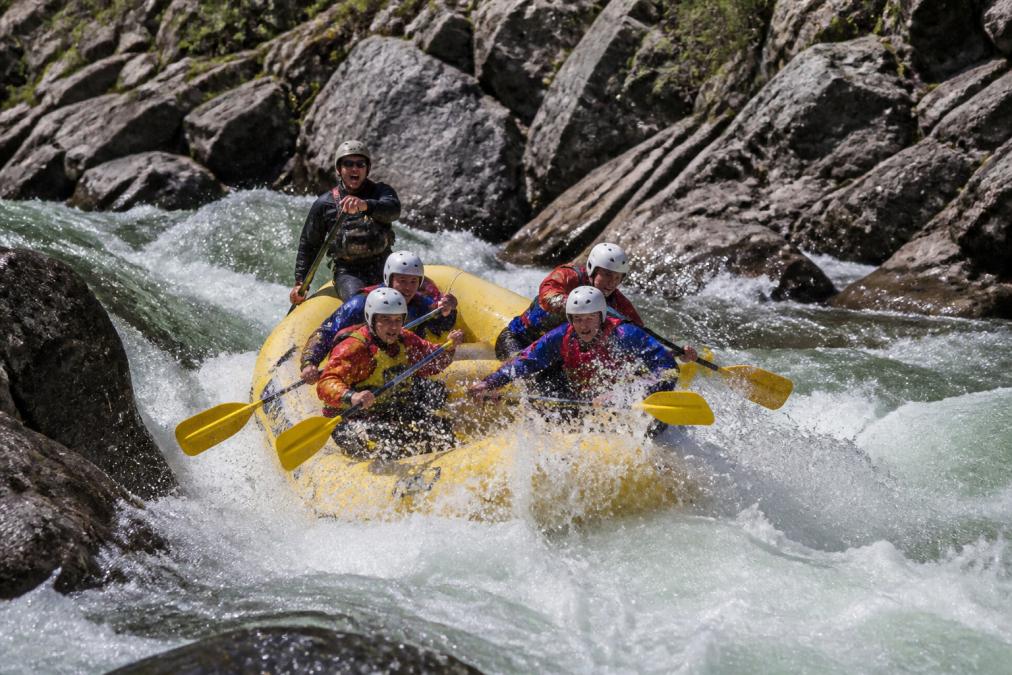
Cherry Creek is the most demanding commercial run in the country, with near-continuous Class V technical rapids and steep gradient drops. It is a dam-controlled stretch of the Upper Tuolumne, so flows depend on release schedules rather than rainfall. Sierra Mac was a pioneer in Class V commercial rafting on Cherry Creek, and that experience matters on a run where rapid scouting and precise commands are standard.
North Fork American River: Spring Class IV/V Day Trips
The North Fork of the American River delivers a 9 to 11-mile run of Class IV/V rapids, according to American Whitewater’s full-day rafting specifications. It is a spring snowmelt run, which means the window is short and the water is cold. This is the best single-day option for paddlers who want high-intensity technical challenges without a multi-day commitment.
Tuolumne and Merced Rivers: Multi-Day Wilderness Expeditions
The Tuolumne and Merced offer multi-day wilderness corridors with a mix of Class IV and V sections and calmer stretches between them. These trips suit rafters who want remoteness as much as difficulty. Sierra Mac operates on both rivers and sits just 15 miles outside Yosemite’s northwest entrance, which shortens shuttle logistics.
| Destination | Rapid Class | Season | Trip Length | Gauge / Flow Driver | Best For |
|---|---|---|---|---|---|
| Cherry Creek | Class V | Spring to early summer | 1 day | New Melones Reservoir releases | Elite paddlers |
| North Fork American | Class IV/V | Spring snowmelt | 1 day | Snowmelt, North Fork gauge | Peak runoff thrills |
| Tuolumne River | Class IV/V | Spring to summer | 1-3 days | Dam-influenced + snowmelt | Wilderness expeditions |
| Merced River | Class IV | Spring to summer | 1-2 days | Snowmelt | Scenic technical runs |
For every river on this list, the rapid class is a range, not a fixed number. The gauge reading on the morning of your trip is what determines whether you are paddling a Class IV run or a Class V one.
The Best Time of Year for High Water Rafting in California
The best time of year for high water rafting in California is late spring, typically May through June, when snowmelt and reservoir releases push flows to their peak. The 2026 season is projected to run long with steady flows, supported by solid reservoir levels, according to All-Outdoors California Whitewater Rafting’s 2026 season update.
How to Read a Dam Release Schedule
On dam-controlled runs like Cherry Creek, the flow you get is the flow the operator releases. Release schedules are published in advance by the agencies that manage the dams, the Bureau of Reclamation and the U.S. Army Corps of Engineers for most western rivers, and typically show a release in cubic feet per second (CFS) by hour or block of hours.
A few practical rules experienced paddlers use:
- Look at the trend, not just the number. A steady release holds the run’s character all day. A ramping release means the water you scout at the put-in is not the water you paddle at the take-out.
- Check the difference between release and gauge. The release is what leaves the dam; the gauge is what is actually in the river at the run. Tributaries, diversions, and travel time sit between them. The gauge is the number that matters for your trip.
- Know your river’s sweet spot. Every technical run has a CFS range where it is at its best. Below it, rapids turn rocky and technical; above it, pushy with higher consequences.
- Watch the schedule in the 72 hours before your trip. Releases can change for power demand, irrigation, or downstream needs, and a schedule posted a month out is not a guarantee.
Ask your outfitter for the projected CFS range for your trip date, not just the rapid class. On dam-controlled runs, the release schedule is the single biggest factor in how the day actually feels. On snowmelt runs, the gauge is.
Snowmelt Runs vs. Dam-Controlled Runs
Snowmelt-fed rivers like the North Fork American peak earlier and drop faster than dam-controlled runs. They follow air temperature and snowpack, so a hot week can push a run to peak and a cool week can hold it back. The window is measured in days, not months.
Why Flow Matters More Than Rapid Class
A run that is Class V at high flow can mellow to Class IV by late summer, and the reverse is true. The same rapid at 1,500 CFS and at 3,000 CFS is two different rapids. At low flow the challenge is technical: tight lines, exposed rocks, precise boat placement. At high flow it is power: bigger hydraulics, faster current, less margin for a missed stroke.
Never assume a posted rapid class reflects the flow on your trip date. Confirm the projected CFS with your outfitter and cross-check it against the live gauge before you launch.
Class V Whitewater Rafting Safety Requirements and Gear
Class V whitewater rafting safety requirements start with a properly fitted PFD, a helmet, and either a wetsuit or drysuit depending on water temperature. Cold snowmelt water in the 40s to 50s demands a drysuit, not just a wetsuit.
- PFD: Coast Guard-approved, snug, and checked by your guide
- Helmet: Required on all Class IV-V commercial runs
- Drysuit or wetsuit: Match to water temperature, not air temperature
- Footwear: Secure shoes that stay on if you swim
- Throw bag: Carried by guides, and worth knowing how to use
Benefits of Multi Day Rafting Expeditions for Serious Paddlers
The benefits of multi day rafting expeditions come down to access and progression. Multi-day trips reach corridors day trips cannot, with fewer crowds and longer stretches of uninterrupted whitewater. They also let you build technique across varying flows instead of cramming everything into one run.
Self-Guided vs. Commercial Logistics: What Experienced Rafters Should Know
Self-guided rafting gives experienced paddlers full control over pace and permits, but shifts every logistics burden onto you: shuttle, wilderness permit, put-in and take-out scouting, and your own safety equipment. On remote corridors, that is a significant time commitment before you touch the water.
How to Choose an Outfitter for Advanced Whitewater Rafting California Trips
Choose an outfitter based on Class V experience, guide tenure, and river-specific knowledge, not on the lowest price. Outfitters with decades of operation on the same rivers, such as those with 60-plus years in the industry, tend to have the deepest familiarity with flow patterns and hazard locations. OARS, for example, has over 50 years of experience operating on 6 different rivers, according to OARS company history.
Use this checklist before you book:
- Confirm the outfitter runs the specific river at the class you want
- Ask how many seasons the average guide has on that river
- Verify swiftwater rescue training for all guides
- Ask what safety equipment is carried on the raft
- Check the cancellation and flow-contingency policy
- Confirm whether shuttle logistics and permits are included
Frequently Asked Questions
Where is the best whitewater rafting in California for experienced rafters?
Cherry Creek on the Upper Tuolumne River is widely recognized as the hardest commercially rafted whitewater in the United States, making it a top choice for expert paddlers. The North Fork of the American River offers a 9 to 11-mile run of Class IV/V rapids during spring snowmelt. For multi-day wilderness trips, the Tuolumne and Merced rivers near Yosemite provide sustained Class IV/V challenges with overnight camping.
What is the best time of year for high water rafting in California?
The best time of year for high water rafting in California typically runs from April through June, when snowmelt feeds rivers and reservoir releases peak. Cherry Creek and the North Fork American River depend on spring runoff, while dam-controlled runs like the Tuolumne can offer reliable flows into summer.
What safety gear is required for Class V whitewater rafting?
Class V whitewater rafting safety requirements include a properly fitted PFD (personal flotation device), a helmet, and either a wetsuit or drysuit depending on water temperature. Rafts carry throw bags, first-aid kits, and repair supplies. Many outfitters also require paddlers to complete a swim test and review swiftwater rescue procedures before launching. Commercial trips supply most gear, but confirm what is provided before booking.
Is a multi-day rafting trip better for experienced rafters?
Multi-day rafting expeditions offer benefits that day trips cannot match: access to remote river corridors, more time on technical rapids, and the chance to build paddling technique over consecutive days. Overnight trips on the Tuolumne or Merced let you reach wilderness sections inaccessible to single-day runs. For experienced rafters, the added logistics and cost are often worth the deeper immersion and skill progression.
How do I choose an outfitter for advanced whitewater rafting in California?
Look for outfitters with decades of operating history on the specific rivers you want to run. Sierra Mac, founded in 1965, was the first to guide on the Merced and Tuolumne rivers and pioneered commercial Class V trips on Cherry Creek. Check guide experience, safety protocols, group sizes, and whether the outfitter runs the river regularly, since local knowledge matters most on technical runs.
Finding a Class V trip that matches your actual skill level, not just your ambition, takes more than a quick search. Sierra Mac runs expert-led day and multi-day expeditions on the Tuolumne, Merced, and Cherry Creek rivers, with professional local guides, access to a range of trip intensities, and a base just 15 miles from Yosemite’s northwest entrance. Get started with Sierra Mac and book a trip built for paddlers who have already earned their stripes.