
Whitewater Rafting Age and Weight Requirements: What to Know
Quick Summary
Whitewater rafting age and weight requirements are set by each outfitter, not by one universal rule, and they change with the river class, the trip and the season. Minimum ages commonly rise from roughly 5 to 7 on Class I to II water to 16 to 18 and up on Class V, while weight rules hinge on whether your life jacket and helmet fit properly. Confirm your trip’s rules in writing before you book.
- Each outfitter sets its own age and weight limits for each trip.
- Minimum age rises with rapid class, from about 5 to 7 on Class I to II water to 16 to 18 on Class V.
- Early-season high flows often raise minimum ages, and lower flows later in summer can lower them.
- Weight rules reflect boat balance and whether a personal flotation device fits securely.
- Ask whether your number is a hard maximum, a minimum, or only a recommendation before paying.
Table of Contents
- Whitewater Rafting Age and Weight Requirements: What to Know
- How Age and Weight Requirements Work for Whitewater Rafting
- Minimum Age by Trip Type and River Difficulty
- Whitewater Rafting Weight Limit and Minimum Weight Rules
- Plus-Size Whitewater Rafting: Fit, Gear and Questions to Ask
- Whitewater Rafting Rapid Class for Beginners
- How Water Flow and Season Change Eligibility
- Booking Your Trip: Confirming Eligibility With Sierra Mac
- Frequently Asked Questions
Whitewater Rafting Age and Weight Requirements: What to Know
Last Updated: November 7, 2026
Whitewater rafting age and weight requirements are not one universal rule. Each outfitter sets its own limits, and those limits change with the river, the trip and the season. At Sierra Mac, we have offered whitewater rafting on the Tuolumne, Merced and Cherry Creek rivers since 1965, and we know that a clear answer before you book saves families a lot of worry. Below, we explain how the rules work, what changes them, and how to confirm eligibility before you pay. Watch out: an age or weight that works for one trip may not apply to a harder river on the same day.
How Age and Weight Requirements Work for Whitewater Rafting
Age and weight limits are set by each outfitter, not by a single national standard. Published examples differ widely. Eligibility should be checked with the outfitter for the specific trip you want.
Think of the requirements as three separate questions:
- Is there a minimum age? Many trips set one, and it often depends on the river.
- Is there a minimum or maximum weight? Weight rules usually relate to safe boat balance and fit of safety gear.
- Does the trip’s difficulty change the answer? Harder water usually means stricter rules.
Study of commercial whitewater rafting trips and guest injuries in West Virginia, 2017 to 2021
Minimum Age by Trip Type and River Difficulty
Minimum age is not a single number you can look up once. It is a decision each outfitter makes for each trip, and it moves with the river class, the day’s flow, and the equipment on the boat. The practical result is that the same river can have a lower minimum age in late summer than it did in June. Sierra Mac’s trips range from mild half-day floats to intense multi-day Class V expeditions, so the right age depends on the specific run and the current conditions.
A common pattern among outfitters is to set age floors by rapid class, then adjust them up when flows are high:
- Class I to II (mild floats): Often open to children as young as 5 to 7 with an adult, provided a child-sized PFD fits properly. Some operators set no minimum age but require a parent or guardian to accompany each child.
- Class III: Frequently a minimum age of 8 to 12, with a swimming requirement and a mandatory adult. Many outfitters raise this to 12 or older during high-water periods early in the season.
- Class IV: Commonly 14 to 16 and up, with demonstrated swimming ability and good physical fitness. Some operators require prior rafting experience or a guide-led check before booking.
- Class V: Typically 16 to 18 and up, often with a fitness screening and a signed acknowledgment of risk. A few operators reserve Class V for adults only.
These are starting points, not guarantees. The exact minimum for your trip is whatever the outfitter confirms in writing for your date.
Children and Youth on Class III and Class IV Water
Meeting the minimum age is only the first test. On Class III and Class IV water, a child also needs to be able to follow commands in a loud, fast environment, stay calm if the raft spins or a wave breaks over the bow, and hold a paddle position for the length of the trip. A strong swimmer who has never rafted can still find big rapids overwhelming.
For teens around 12 to 14, the answer often hinges on flow. Early-season flows are higher, so many outfitters raise the minimum age or require a swim test. Later in summer, when flows drop, some operators lower the age floor by two or three years. That is why an age that worked last month may not apply now.
Ask the outfitter whether they require a swim test or a prior Class III trip before booking a harder run.
Study of commercial whitewater rafting trips and guest injuries in West Virginia, 2017 to 2021
The minimum age depends on the rapid class, so the table below sets out the starting points the article gives for each class.
| Rapid class | Typical minimum age | Key condition |
|---|---|---|
| Class I to II | Often 5 to 7, with an adult | Child-sized PFD must fit properly |
| Class III | Often 8 to 12 | Swimming requirement and mandatory adult |
| Class IV | Commonly 14 to 16 and up | Demonstrated swimming ability and fitness |
| Class V | Typically 16 to 18 and up | Fitness screening and signed risk acknowledgment |
Typical minimum age by rapid class
Whitewater Rafting Weight Limit and Minimum Weight Rules
Weight rules exist for two separate reasons, and confusing them is the most common source of booking surprises. The first is boat balance: a raft trims best when the load is distributed within a range the guide can manage. The second is equipment fit: a participant must be able to wear a personal flotation device (PFD) and helmet that stay in place in moving water. Outfitters translate those two concerns into three different kinds of numbers, and they are not interchangeable.
- Hard maximum weight: A firm cap, usually set by the PFD’s rated capacity or the raft’s load limit. Above it, the outfitter cannot legally or safely equip you, and no conversation changes the answer.
- Minimum weight: Usually applied to children, and usually tied to the smallest PFD the outfitter stocks. A child below the minimum may not be able to wear a standard jacket snugly enough to stay afloat face-up.
- Recommended weight range: Advice, not a rule. An outfitter may suggest a range for comfort or paddle reach but allow exceptions after a fit check and a conversation about fitness and swimming ability.
Ask the outfitter which category your number falls into before you pay.
Weight is not the only factor. Fitness, swimming ability, and comfort in the water matter too, and a participant near a maximum may still be cleared if the gear fits and the guide is comfortable with the load.
Weight Limits Versus Weight Recommendations
A weight limit is a hard rule. A weight recommendation is advice. For example, an outfitter may recommend a certain range but allow exceptions after a conversation about fit and fitness. Always ask which one applies, because a “limit” may be firm while a “recommendation” can be discussed.
What Happens When Standard Gear Does Not Fit
PFD fit is the real test behind most weight rules, and it is worth understanding before you book. A jacket fits correctly when it cinches snug at the shoulders and waist, does not ride up when you raise your arms, and keeps your chin clear of the collar. If a standard jacket cannot be cinched snug, the outfitter has three options: supply a larger or extended-size PFD, move you to a boat or position with a different load limit, or decline the booking. Ask which of those your outfitter can do.
Questions worth asking before you book:
- Does the trip’s maximum weight apply to total body weight or to fit in the boat and PFD?
- Do you stock extended-size PFDs and helmets, and what is the largest size available?
- Will I be seated where I can paddle comfortably and reach the guide’s commands?
- If my gear does not fit at the put-in, what is your refund or rebooking policy?
Watch out: a PFD that closes but rides up when you raise your arms is not a safe fit; ask for a different size before the raft leaves the put-in, not after.
Whitewater safety standards and risk management practices in the Ottawa Valley rafting industry
Plus-Size Whitewater Rafting: Fit, Gear and Questions to Ask
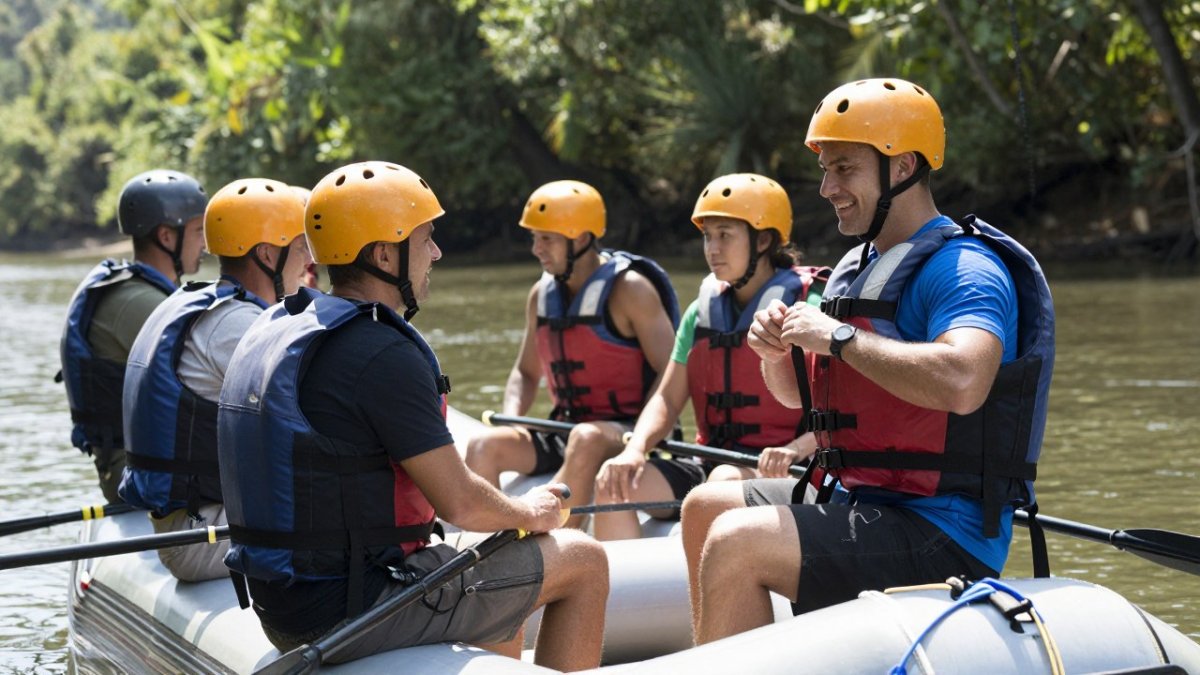
Larger participants can raft safely, but gear fit matters most. Ask the outfitter whether they carry larger life jackets and helmets, and whether your size fits their standard equipment. A jacket that does not close or sit snugly can be unsafe, so the fit check is important.
Questions worth asking before you book:
- Does the trip’s maximum weight apply to my total body weight or to my fit in the boat?
- Do you have PFDs and helmets in larger sizes?
- Will I be seated in a position where I can paddle comfortably?
- Is a lower-difficulty trip a better fit for my fitness level?
Whitewater Rafting Rapid Class for Beginners
If you have never rafted before, start with a mild river and a shorter trip. Rapid classes run from Class I (easy) to Class V (very difficult). A first-time rafter with decent swimming skills usually does well on Class II or III water. Class IV and V trips are better suited to experienced paddlers or confident older teens and adults. Read what to expect on Class V rapids to understand the demands of the hardest water.
Our Class V safety techniques and fitness guidelines explain what harder water demands. Reading them before you choose a trip can help you pick the right river. Class V safety guidelines
How Water Flow and Season Change Eligibility
Water flow changes the rules. Early in the season, when flows are high, rapids are bigger and minimum ages are usually higher. Later in summer, flows drop, and some outfitters lower the age limit.
Because flows change from week to week, an age that worked last month may not apply now. Check the current river level and the outfitter’s rules close to your booking date.
Whitewater rafting with teenagers guide describing seasonal age minimums
Booking Your Trip: Confirming Eligibility With Sierra Mac
Before you book, confirm three things with Sierra Mac: the minimum age for your trip, any weight rules, and whether your gear fits. Check current dates and pricing on our website, or contact our team for a quote. See current prices and schedules for Cherry Creek/Upper Tuolumne, Main Tuolumne, and Merced trips. Compare the combination rafting trips on Cherry Creek/Upper Tuolumne and Main Tuolumne before you reserve.
If you have a question that is not covered there, contact our team before you pay. Our frequently asked questions about age, weight and policies give quick answers first. Clear answers up front help every family enjoy the river.
Frequently Asked Questions
Can a 7-year-old go whitewater rafting?
Most outfitters set their minimum age for whitewater trips at around 9 to 12 years old, and the age depends heavily on the river and season. A 7-year-old usually does not meet the minimum for a whitewater trip, so families with younger children should look for calmer float options or confirm directly with the outfitter before booking.
Are Class IV rapids safe for kids?
Class IV rapids are powerful and demanding, so they are generally reserved for older, strong swimmers who are comfortable following safety instructions. Whether a child is ready depends on the trip, the water level and the child’s maturity, not only on age. Families with children aged 12 and up should ask the outfitter whether the chosen river section suits their child, and whether a milder trip would be a better first experience before stepping up to Class IV water.
Is there a weight limit for whitewater rafting?
Yes, many outfitters set both minimum and maximum weight guidelines, and they differ between companies and trips. Because requirements vary, check the current limit with the outfitter before booking, and ask how the limit applies to personal flotation device fit and boat capacity.
Can a beginner go whitewater rafting on Class III rapids?
Beginners are often placed on Class III water, which is a common starting point for first-time rafters with reasonable fitness and swimming ability. Class III rapids involve moderate waves and maneuvering, and guides usually provide clear paddling instructions. Confirm the specific trip with the outfitter, share any experience or fitness concerns, and ask how the guides will adjust the route if conditions change.