
How to Find Beginner Friendly Whitewater Rivers
Last Updated: November 25, 2026
Quick Summary
A beginner friendly whitewater river has steady flow, readable rapids with clear routes around obstacles, and long flatwater stretches between drops for recovery. Most first trips run Class I through III water, and you should check the river’s current flow before booking.
- Look for readable rapids with obvious routes around big rocks, visible from the bank.
- Ask the outfitter for the hardest rapid on the route, since one drop can set the difficulty.
- Match the class to your comfort swimming in moving water, not just your excitement level.
- Check the river’s cfs reading on a USGS gauge and whether it is rising, falling, or steady.
- Start with a guided rafting trip, since the guide handles route choice and water reading.
Table of Contents
- What Makes a Whitewater River Suitable for Beginners
- Reading Whitewater River Difficulty Ratings
- How River Flow and Water Levels Change Difficulty
- Rafting Versus Kayaking: Choosing the Right Craft
- Beginner Whitewater Rafting Safety Tips
- Why a Guided Trip Is the Safest Starting Point
- Booking Your First Beginner-Friendly River Trip with Sierra Mac
- Frequently Asked Questions
What Makes a Whitewater River Suitable for Beginners
Finding a beginner friendly whitewater river starts with understanding what makes water manageable. Most calm-to-moderate rivers have consistent flow, wide channels, and rapids with clear lines through them.
Look for a few specific traits when you evaluate a river. Rapids should be clearly readable from the bank, with obvious routes around big rocks.
Watch out: a river that looks gentle at one flow can turn hard at another. Always check the current conditions before you commit to a trip.
For a curated list of rivers that fit these criteria, see our guide to 7 Best Whitewater Rafting Rivers for Beginners. Our own approach to beginner trips is covered in Is Class 5 Rafting Safe for Beginners? What to Know, which explains how difficulty ratings map to what a first-timer will actually experience.
Reading Whitewater River Difficulty Ratings
The International Scale of River Difficulty rates rapids from Class I to Class VI. Class I water is essentially flat with small waves. Class VI is considered nearly impossible and extremely dangerous.
For a beginner friendly whitewater trip, remember that ratings describe the hardest rapid on a stretch, not the average. A river rated Class II may have a single Class III drop that determines the overall experience. Ask the outfitter for the highest rating on the route and how many rapids reach it.
Class I to Class III: What Beginners Can Expect
Class I water has moving current with few obstacles. Class II adds small rapids with regular waves and easy maneuvering. Class III brings bigger waves, more irregular water, and a need to steer around obstacles.
A useful rule of thumb: match the class to your comfort with swimming in moving water, not just to your excitement level. If you are not confident you could float through a rapid and self-rescue, stay at Class II until you have taken a guided trip or a swiftwater safety course.
How to Use a Rating to Evaluate a Specific River
Ratings are a starting point, not a verdict. When you look at a river description, read past the headline class and check four things:
- The hardest rapid, not the average. A Class II run with one Class III drop is a Class III experience for the person who has to run that drop. Ask where the hardest rapid falls on the route and whether there is a portage or walk-around option.
- Rapid frequency and spacing. A stretch with one Class II rapid and long flatwater between is gentler than a continuous Class II run with no recovery pools. Look for language like “pool-drop” (calm pools between rapids) versus “continuous” or “boulder garden.”
- Hazards that ratings do not capture. Strainers (fallen trees), undercut rocks, sieves, and low-head dams can make a Class II rapid dangerous out of proportion to its rating. River descriptions from American Whitewater and local outfitters usually call these out.
- Access and rescue. A run with road access along the bank and a short walk to the put-in is easier to manage than a remote stretch where a swim would be a long, cold float. For a first trip, favor rivers with established access points and nearby outfitters.
Why Ratings Change with Conditions
A rapid’s rating can shift with water level. High flows wash out obstacles and produce bigger waves, which can push a Class III run toward Class IV. Low flows expose rocks and create tight channels.
Watch out: a river described as “Class II at normal flows” can become a different run after heavy rain or during spring snowmelt. Always ask the outfitter what class the river is running at today, not what class it carries in a guidebook.
The table below summarises the difficulty classes described in this section so you can compare what each level means for a beginner.
| Class | Description | Beginner note |
|---|---|---|
| Class I | Essentially flat with small waves | Easiest; moving current with few obstacles |
| Class II | Small rapids with regular waves | Common for first-timers |
| Class III | Bigger waves, irregular water | Reasonable next step after basic skills |
| Class IV | Harder than Class III | Not a typical beginner level |
| Class V | Extremely difficult | Not suitable for beginners |
| Class VI | Nearly impossible and extremely dangerous | Avoid |
How River Flow and Water Levels Change Difficulty
Flow is one of the most important factors in whitewater difficulty, and it is the factor first-timers most often overlook. The USGS operates streamflow gauges across the United States, and its National Water Dashboard publishes current readings for many rivers (usgs.gov).
As flow rises, rapids generally get bigger and harder to read, but calmer stretches can also get shorter and faster. As flow drops, rocks become more exposed and the margin for error shrinks. Beginners generally do best at moderate, steady flows that are within the range an outfitter normally runs.
How to Read a River Gauge Before You Book
You do not need to be a hydrologist to use gauge data. Follow this sequence:
- Find the gauge for your stretch. Search the USGS National Water Dashboard by river name or state, or ask the outfitter which gauge they watch. Many popular beginner runs have a dedicated gauge with a real-time cfs reading and a graph of recent days.
- Look at the trend, not just the number. A rising hydrograph after a storm means the river is still coming up and may peak higher than the current reading. A flat or slowly falling line is generally more predictable for a beginner trip.
- Compare to the outfitter’s range. Outfitters publish or will tell you the cfs range they typically run. If the current reading is inside that range and steady, conditions are likely in the beginner-friendly band. If it is far above, ask whether the trip will run at all and how the route changes.
- Check for scheduled releases. Some dam-controlled rivers run on published release schedules rather than natural flow. A release can turn a mild stretch into a bigger-water day, so confirm the release schedule for your date.
What Flow Changes on the Water
High flow does more than make waves bigger. It can wash out eddies that a raft would normally use to stop and regroup, shorten flatwater recovery stretches, and push a beginner route toward the next class up. Low flow creates the opposite problem: exposed rocks, tighter channels, and more technical maneuvering around obstacles that are normally submerged.
A common pattern is that the same river offers a forgiving beginner window for a few weeks in a season and a much harder run outside it. That is why a river’s rating alone does not guarantee beginner-friendly conditions on your date.
A Quick Flow Checklist for Beginners
- Confirm the gauge reading and whether it is rising, falling, or steady.
- Ask the outfitter for their typical cfs range and where today’s reading falls.
- Check whether the river is dam-controlled and whether a release is scheduled.
- Ask how the route changes at the current level, which rapids get bigger, which eddies disappear.
- If the reading is outside the normal range, treat the trip as a different river and ask whether a gentler stretch or date is available.
Watch out: a gauge reading that looks low can still mean dangerous conditions if the river is dropping fast after a spike, because debris and unstable banks often follow high water. Ask the outfitter how recently the river peaked.
Rafting Versus Kayaking: Choosing the Right Craft
Rafting and kayaking both put you on whitewater, but the learning curves differ. Rafts are stable, carry several people, and rely on a guide who steers from the back.
Kayaking demands more individual skill. You control your own boat, must learn to roll if you flip, and need to read water and make fast decisions alone.
If you want to compare the two more closely, our article Rafting vs Kayaking for Beginners: Which to Try First walks through the trade-offs in detail.
Beginner Whitewater Rafting Safety Tips
Safety starts before the river. Wear the life jacket and helmet the outfitter provides, and keep them fastened the whole time. Listen to the safety briefing and learn the paddle commands, since most rafts are steered by the guide calling out instructions.
- Stay seated and keep your feet inside the raft, with your feet under the thwart.
- Hold your paddle with both hands and keep it close to the boat when not in use.
- If you fall in, float on your back with your feet pointed downstream and your head up.
- Tell the guide early if you feel unwell, scared, or unable to swim.
A common mistake is treating the first rapid as a test of toughness. Speak up if you feel out of your depth before the trip gets moving.
Why a Guided Trip Is the Safest Starting Point
A guided trip puts a trained professional in charge of route selection, water reading, and emergency response.
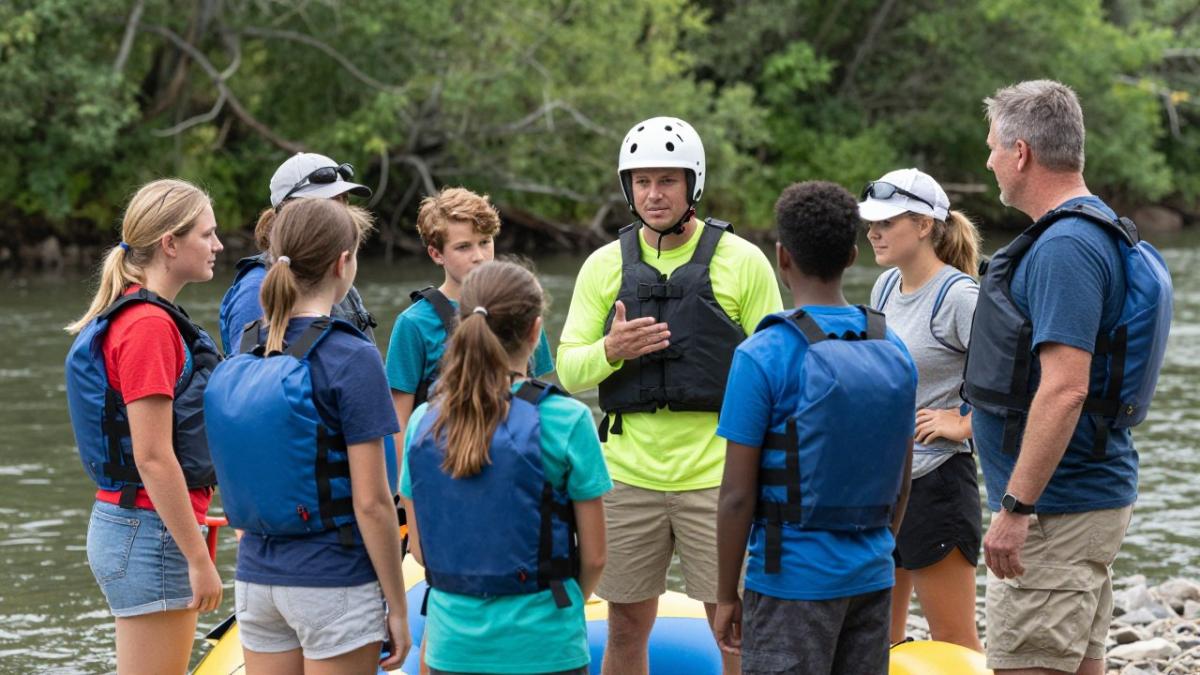
Guides can help beginners build confidence between harder sections of a river. A guided trip is a common way for first-timers to try whitewater.
Before you book, ask the outfitter how many guides will be on the water, what their training covers, and how they handle changing conditions. Good operators answer these questions readily.
Booking Your First Beginner-Friendly River Trip with Sierra Mac
Once you know which river and craft suit you, the next step is choosing a trip length and date.
To compare the trips we offer and find the right fit for your group, visit the rafting trip options on our site.
For more on the beginner rafting experience, our guide Is Class 5 Rafting Safe for Beginners? What to Know explains what to expect from a higher-difficulty trip so you can choose the right level.
Ready to plan your first trip? Visit Sierra Mac’s website to book.
Frequently Asked Questions
What is a good first whitewater kayak for a beginner?
For a first whitewater kayak, most beginners look for a stable, forgiving sit-on-top or recreational whitewater kayak with a wide hull and generous primary stability. Shorter boats turn more easily in current, which helps when you are learning to ferry and eddy out. Before buying, take a lesson or a demo day with a paddle shop or outfitter so you can test how a boat handles in moving water. Rental on a Class I to II river is a low-cost way to decide whether kayaking suits you before you invest.
Can beginners do whitewater rafting?
Yes. Whitewater rafting is one of the most accessible ways for beginners to experience moving water, because a guide steers and crew members paddle together. Most commercial operators run beginner trips on Class I to III water, and many accept children from around age 12 or older depending on the river and operator. Choose a trip with a licensed or experienced guide, read the trip description for difficulty and minimum age, and tell the outfitter about any fitness or medical concerns when you book.
What class rapids are good for beginners?
Class I and Class II rapids are usually the best starting point. Class I water is moving water with small waves and few obstacles. Class II adds more regular waves and simple maneuvering, and is a common first experience for rafting novices. Class III rapids have more irregular waves and require more precise technique, so many beginners should build experience on lower classes first. Ratings are general guides, and conditions can shift a rapid’s difficulty from one day to the next.
What should beginners check before choosing a whitewater river?
Start by checking the river’s class rating and whether the operator describes it as beginner-friendly. Then look at current flow levels, since high water can make a Class II stretch feel like Class III. Confirm the minimum age, swimming requirements, and whether the trip includes life jackets and a guide. Finally, ask about the put-in and take-out logistics and whether shuttle service is included. For the latest trip details and availability, contact Sierra Mac directly or visit its website for a current quote.