
What CFS Levels Mean in Whitewater Rafting
Last Updated: November 24, 2026
Quick Summary
CFS levels in whitewater rafting describe how much water moves past a point each second, not how fast the current runs. CFS stands for cubic feet per second, a measure of river discharge: the volume of water flowing through a channel in one second. A wide, deep channel can push a huge volume through at a lazy pace, while a narrow gorge can move far less water at terrifying speed.
- A cubic foot holds about 7.48 gallons, so 1 CFS is roughly 7.5 gallons per second.
- Find the gauge closest to your put-in, not the nearest town, and confirm its location on the map.
- Read the trend graph, not just today’s reading, since a fast rise is the most common reason trips get moved.
- There is no universal good CFS; learn your home river’s low-water floor, sweet spot, and high-water ceiling.
- Match the flow to the least experienced person in the boat, not the most confident one.
Table of Contents
- CFS River Flow Meaning: Volume, Not Speed
- How to Calculate CFS Water Flow and Read a Gauge
- What Is a Good CFS for Kayaking and Rafting?
- How Flow Levels Change Rapid Difficulty and the Ride
- Why CFS Thresholds Cannot Be Generalized Across Rivers
- How to Check River Flow Before Rafting and Make a Safety Call
- Book a Guided Trip Matched to the Day’s Flow
- Frequently Asked Questions
CFS River Flow Meaning: Volume, Not Speed
CFS levels in whitewater rafting describe how much water moves past a point each second, not how fast the current runs, and reading CFS levels correctly is the first skill every guide learns. CFS stands for cubic feet per second, a measure of river discharge: the volume of water flowing through a channel in one second (USGS CIRCULAR 1169 subpage: GLOSSARY).
Here’s the part most guides skip. A river can carry twice the water at the same speed, or the same water at twice the speed. CFS captures only the first half of that equation. A wide, deep channel can push a huge volume through at a lazy pace.
So when you hear guides say “the river’s at 2,000,” they mean volume. Speed comes from the river’s gradient, its channel shape, and how much water is stacked behind it.
How River Discharge Is Measured
River discharge is the total volume of water passing a fixed point per unit of time. (stream discharge) Hydrologists calculate it by multiplying the channel’s cross-sectional area by the average water speed.
In practice, that means surveyors wade out with a flow meter, measure depth and speed at many points across the channel, and add it all up.
The National Park Service research on measuring river flow from images of rapids shows how far this science has come.
How to Calculate CFS Water Flow and Read a Gauge
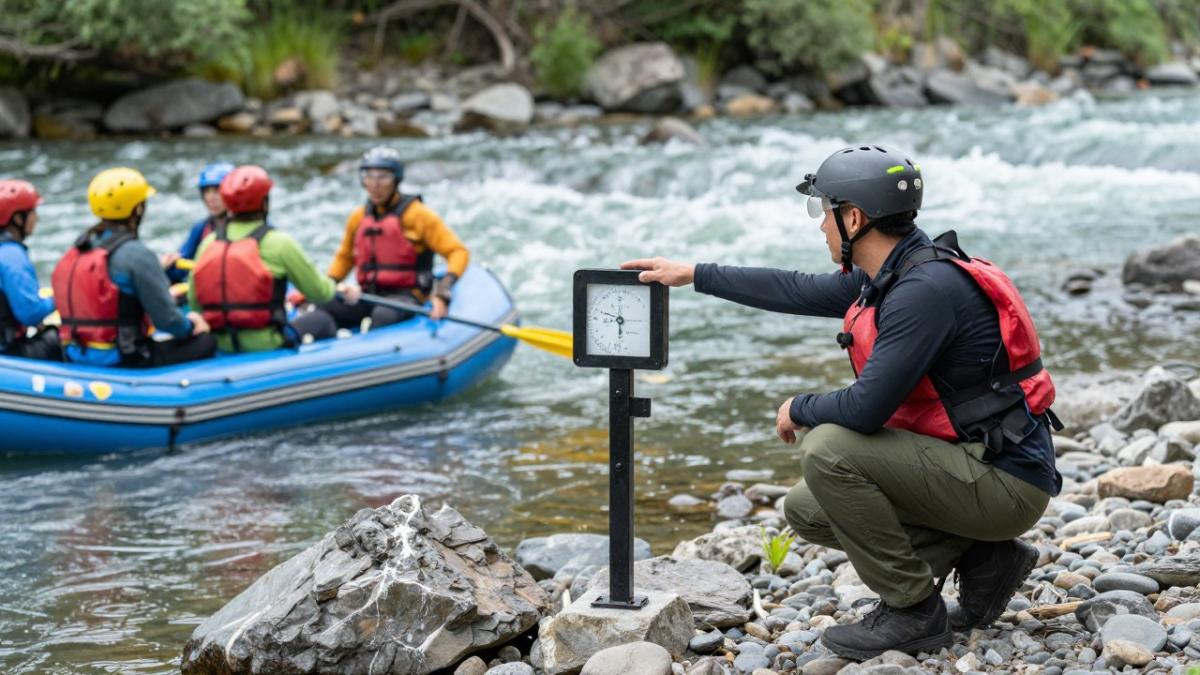
You rarely need to calculate CFS water flow by hand. The USGS publishes real-time discharge data for thousands of gauges, free and updated frequently. Your job is reading it correctly, and that means more than glancing at today’s number.
Step-by-Step: Checking a USGS Gauge
- Find the gauge closest to your put-in, not the nearest town. Rivers change fast between gauges, and a gauge below a major tributary can read far higher than the water you will actually launch onto.
- Confirm the gauge location on the map, including whether it sits above or below a dam, diversion, or confluence. That placement determines whether the number reflects your stretch at all.
- Read the discharge number in CFS alongside the gage height, the water-surface elevation the gauge actually measures. Discharge is computed from gage height using a rating curve built for that site, so a shifted channel can throw the conversion off until the curve is updated.
- Look at the trend graph, not just today’s reading. A river climbing from 900 to 1,400 CFS overnight is a different proposition from one holding flat at 1,400.
- Note the date and time of the reading. Gauges update at different intervals, and some transmit only every few hours.
- Compare the reading with the river-specific operating range published by the managing agency or local outfitter, not with a number borrowed from another river.
- Cross-check with the outfitter or land manager for dam releases, scheduled flow changes, and local hazards the gauge cannot show.
Reading the Trend, Not Just the Number
A single gauge reading is a snapshot. What matters for a launch decision is direction and speed of change.
- Rising flow usually means snowmelt, rain upstream, or a dam release. Rising water pushes debris downstream, can strand gear, and makes eddies harder to catch. A fast rise is the most common reason trips get moved or postponed.
- Falling flow exposes rocks that were submerged an hour earlier and can leave boats high-centered on lines that worked at higher water. A falling river can still carry strong current and shifted wood long after the gauge drops.
- Stable flow is the easiest to plan around, but confirm it is stable because of natural conditions and not because a gauge is stale or a release schedule is holding it flat.
Watch out: a gauge miles upstream of your launch can mislead you badly when a tributary or dam sits in between. The number at the put-in is the one that matters, and if no gauge sits at the put-in, ask the outfitter which gauge they actually use and how they correct for the gap.
Why the Same Number Means Different Things on Different Rivers
A CFS reading is only meaningful against the river it came from. Channel width, depth, gradient, and the gauge’s own location all change what a given discharge feels like on the water. A narrow, steep gorge can turn a modest flow into pushy whitewater, while a wide, low-gradient channel can absorb the same volume with far less drama. That is why copying another river’s numbers is a mistake, and why the gauge for the river you are actually running is the only one worth planning around.
What Is a Good CFS for Kayaking and Rafting?
There is no universal “good” CFS. A flow that makes one river a gentle float can make another a serious commitment. The honest answer: good CFS is whatever range the local gauge and local boaters recognize as runnable and appropriate for your group.
What you can do is learn your home river’s bands. Most rivers have a low-water floor below which boats scrape bottom, a sweet spot for general rafting, and a high-water ceiling where commercial trips pause.
Making the Number Tangible: CFS in Gallons and Everyday Volume
A cubic foot holds about 7.48 gallons, so 1 CFS is roughly 7.5 gallons moving past a point every second. That conversion is the fastest way to feel what a gauge is telling you.
- 100 CFS is about 750 gallons per second, roughly a bathtub every three seconds. On most rivers this is a low, technical flow where rocks and shallow lines dominate.
- 1,000 CFS is about 7,480 gallons per second, or roughly a backyard swimming pool every three to four seconds. This is a common mid-range band on many runnable stretches.
- 5,000 CFS is about 37,400 gallons per second, a volume that turns wide channels into fast, feature-rich water and narrow gorges into serious commitments.
These comparisons are illustrative, not thresholds. The point is that CFS measures volume, not speed, so the same gallon count behaves very differently depending on how wide, deep, and steep the channel is.
Matching Flow to Trip Intensity
Once you know your river’s bands, match the flow to the experience you want and the group you are bringing. Low water rewards technical maneuvering and precise boat placement.
If you’re matching flow to trip intensity, our river trips from mild to intense guide maps options by difficulty so you can pick the right level before you ever look at a gauge.
Watch out: a flow that is “good” for a strong, experienced group can be a poor fit for a group with a weakest paddler who is new to whitewater.
These everyday comparisons show what a given discharge actually looks like moving past a point.
| CFS | Gallons per second | Everyday comparison |
|---|---|---|
| 1 CFS | About 7.48 gallons | Roughly 7.5 gallons each second |
| 100 CFS | About 750 gallons | Roughly a bathtub every three seconds |
| 1,000 CFS | About 7,480 gallons | Roughly a backyard pool every three to four seconds |
| 5,000 CFS | About 37,400 gallons | Turns wide channels fast and feature-rich |
How Flow Levels Change Rapid Difficulty and the Ride
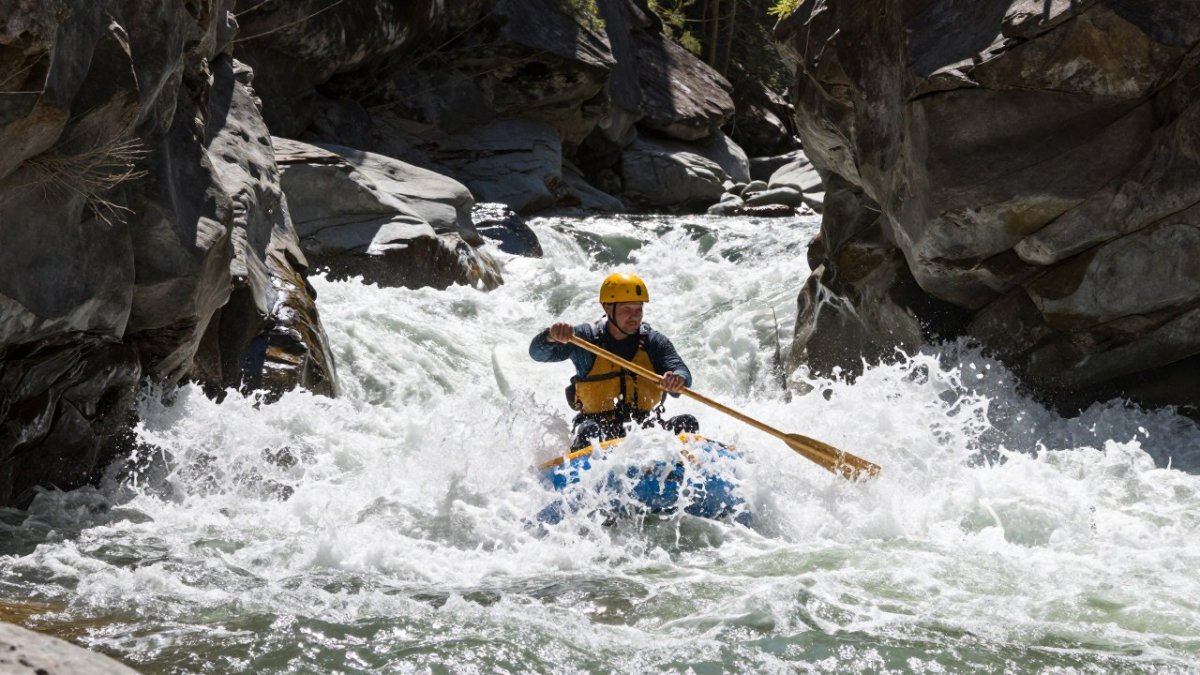
More water usually means bigger features, faster moves, and less margin for error. The same rapid can feel playful at moderate flow and genuinely pushy at high water. Holes get deeper, waves stack taller, and eddy lines sharpen.
Low water brings its own challenges. Rocks that sit harmless at high flow become boat-eaters. Channels narrow. Technical maneuvering matters more than power.
Rapids are rated on the Class I to V scale, and that rating assumes a normal flow range. If you want to know how a step up in class actually feels, read what to expect on a Class IV river trip.
Why CFS Thresholds Cannot Be Generalized Across Rivers
A CFS number means nothing without the river attached to it.
Now compare rivers. A desert canyon run and a Sierra snowmelt river can carry wildly different volumes at the same difficulty. Channel shape, gradient, and width all change what a given flow feels like.
This is why copying another river’s numbers is a mistake. For a direct look at how two specific rivers compare, see our Tuolumne River vs Cherry Creek rafting guide.
How to Check River Flow Before Rafting and Make a Safety Call
Checking flow is only half the job. The other half is deciding what the number means for your group, today.
Run through this before every launch:
- Confirm the gauge reading at your put-in, with timestamp
- Check the trend: rising water is harder to manage than steady water
- Confirm any dam release schedule for the day
- Match the flow to your group’s weakest paddler, not its strongest
- Check weather upstream, since rain changes flow fast
- Verify the commercial season is open at that level
Watch out: a falling river can still be dangerous. High water leaves behind strong current and shifted debris long after the gauge drops. For a deeper look at reading conditions, our guide on river rafting water levels walks through the full picture.
Book a Guided Trip Matched to the Day’s Flow
The safest way to enjoy whitewater at any flow is with guides who read that river every single day.
You get expert guidance from local guides. Ready to see it for yourself? Explore our guided whitewater rafting near Yosemite and pick the trip that fits your group.
Flow numbers only tell you so much. The real river experience comes from being on the water with guides who’ve spent decades learning it.
Frequently Asked Questions
What is a good CFS for rafting?
There is no universal number. A good CFS depends on the specific river, its gradient, and channel shape. A figure that feels lively on one section can be dangerously high on another. Check the gauge for your exact run and ask the outfitter what range they consider ideal for the day.
Does higher CFS always mean more difficult whitewater?
No. Higher CFS means more water volume moving past a point each second, but it does not automatically make a rapid harder. On some sections, more flow washes out holes and makes waves smoother. On others, it creates pushier currents and fewer eddies. Rapid difficulty also depends on gradient, channel shape, and obstacles. That is why CFS levels are river-specific and why guides assess conditions on site rather than relying on a single threshold.
How can I check river flow before a rafting trip?
Start with the USGS Water Data website and search for the gauge on your river section. Look at the current CFS reading, then check the trend over the past 24 to 72 hours. Rising flow after rain or a dam release changes conditions fast. Compare the reading to the outfitter’s recommended range. For a guided trip, contact the outfitter before your booking date to ask how they assess flow conditions.
How do you calculate CFS water flow?
CFS, or cubic feet per second, is discharge: the volume of water passing a point each second. Technicians calculate it by measuring the cross-sectional area of the channel and multiplying it by the average water velocity. In practice, most rafters do not calculate CFS by hand. They read it from a USGS gauge, which uses a rating curve to convert river level into discharge. New research using critical-flow theory also estimates discharge from images of rapids.