7 Best Whitewater Rafting Rivers for Beginners
Last Updated: November 11, 2026
Quick Summary
The best rafting rivers for beginners keep rapids at Class III or below and offer guided trips with a safety briefing. Top picks include the South Fork American, Merced, Nantahala, Upper New, and Lower Kern, all running mostly Class II and III water. Pick the river that matches your group’s least confident paddler, not its boldest.
- Beginners should stay at Class III or below on the six-point whitewater classification scale.
- Late spring through early summer is the best window for most beginners because snowmelt fills rivers.
- Many outfitters set minimum ages around twelve for Class III water and lower for Class II.
- Ask the outfitter to name the hardest rapid on the route and its class before booking.
- A half-day guided trip is the lowest-commitment option and easiest to fit around other plans.
Table of Contents
- 7 Best Whitewater Rafting Rivers for Beginners
- Quick Comparison: Beginner Rivers at a Glance
- Whitewater Rafting Rapid Classes for Beginners Explained
- Best Time of Year for Whitewater Rafting
- What to Wear Whitewater Rafting
- Whitewater Rafting Safety Tips for Beginners
- Choosing Your First Rafting River Near Yosemite
- Frequently Asked Questions
7 Best Whitewater Rafting Rivers for Beginners
Choosing among the best whitewater rafting rivers for beginners usually comes down to one thing: matching the rapid class to your group’s comfort level, not to your ambition.
Below, we rank seven rivers that treat first-timers well, then cover the rapid classes, seasons, gear, and safety basics that decide whether your first trip feels thrilling or overwhelming.
1. South Fork American River, California
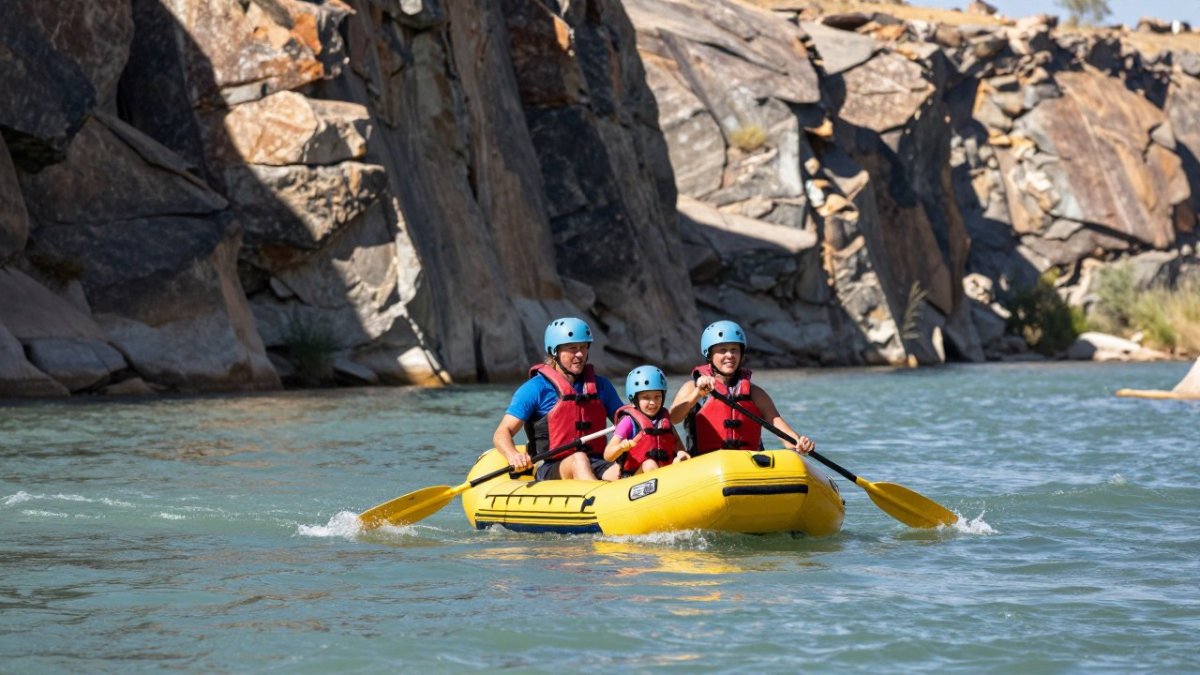
The South Fork American River is a popular first river in California. Its most popular beginner stretch mixes calm floating with a handful of Class II and Class III rapids, so you get real splashes without a steep learning curve. Best for: families and groups who want a full day on the water with plenty of recovery time between rapids. Skip if: you want a remote, crowd-free canyon, because this river gets busy in summer.
2. Tuolumne River, California
The Tuolumne near Yosemite runs the full spectrum. The upper stretch offers mild water suited to first-time rafters, while the famous Class IV main section is a step up for paddlers with a trip or two behind them. Sierra Mac was the first outfitter to guide on the Tuolumne and the Merced Rivers. Best for: travelers who want a Yosemite-area river with options for mixed-ability groups.
3. Merced River, California
The Merced is a gentler Sierra option. Spring runoff feeds Class II and III rapids with long calm stretches, and the scenery through the Merced River Canyon is a draw for many rafters. Best for: first-time rafters who want scenery as much as splash. Skip if: you are chasing big, technical whitewater.
4. Nantahala River, North Carolina
The Nantahala is a river in the Southeast often cited for beginners. Its controlled flow keeps water levels relatively consistent, and the rapids are mostly Class II with a few Class III features. Cold water is the tradeoff, so dress accordingly. Best for: beginners who want predictable conditions and a short, manageable river run.
5. Upper New River, West Virginia
The Upper New delivers a classic beginner-friendly canyon float with Class I to Class III rapids and big scenery. It suits families and groups who want a full day with a wilderness feel. Best for: paddlers who want a longer river section without committing to multi-day logistics.
6. Arkansas River, Colorado
The Arkansas offers beginner stretches alongside more demanding sections, so the section you choose matters. Best for: groups who want a taste of bigger western whitewater with a guided hand.
7. Lower Kern River, California
The Lower Kern is a solid introduction to California whitewater, with Class II and III rapids and warm summer flows. It is a good bridge river: easier than the Tuolumne’s main section, more engaging than a pure float trip. Best for: beginners ready to paddle rather than just ride.
| River | State | Typical Beginner Class | Best For | Watch Out For |
|---|---|---|---|---|
| South Fork American | California | Class II-III | Full-day family trips | Summer crowds |
| Tuolumne | California | Class II-IV by section | Mixed-ability groups | Section choice matters |
| Merced | California | Class II-III | Families with kids | Spring runoff timing |
| Nantahala | North Carolina | Class II-III | Predictable conditions | Cold water |
| Upper New | West Virginia | Class I-III | Wilderness feel | Longer day |
| Arkansas | Colorado | Class II-III (select sections) | Western canyon scenery | Reputation vs. section |
| Lower Kern | California | Class II-III | Stepping up from floats | Summer heat |
Quick Comparison: Beginner Rivers at a Glance
The table above is the short version. If you only read one line, read this: a beginner river is any run where the rapids stay at Class III or below and the outfitter offers a guided trip with a safety briefing. Everything else, from scenery to season, is preference.
Three factors separate a good first river from a great one:
- Rapid class consistency: a river that stays Class II-III throughout is easier to prepare for than one with a single surprise Class IV.
- Water level stability: dam-controlled rivers like the Nantahala behave predictably; free-flowing Sierra rivers change with snowmelt.
- Guide-to-guest ratio: smaller rafts with a guide in every boat mean faster rescues and clearer paddle commands.
Whitewater Rafting Rapid Classes for Beginners Explained
Whitewater classification is a six-point scale, from Class I flat water to Class VI unrunnable, and beginners should stay at Class III or below. The classes describe difficulty, risk, and the skill needed to read the water.
Here is what each class means in practice, not just on a chart:
- Class I: moving water with small riffles and wide, obvious channels. You can drift most of it. Minimal maneuvering, and a good fit for very young children or anyone who wants a float rather than a paddle.
- Class II: clear channels and easy rapids with waves that splash but do not stop the boat. First-timers handle these with basic paddle commands. This is the sweet spot for a nervous group or a mixed-age family.
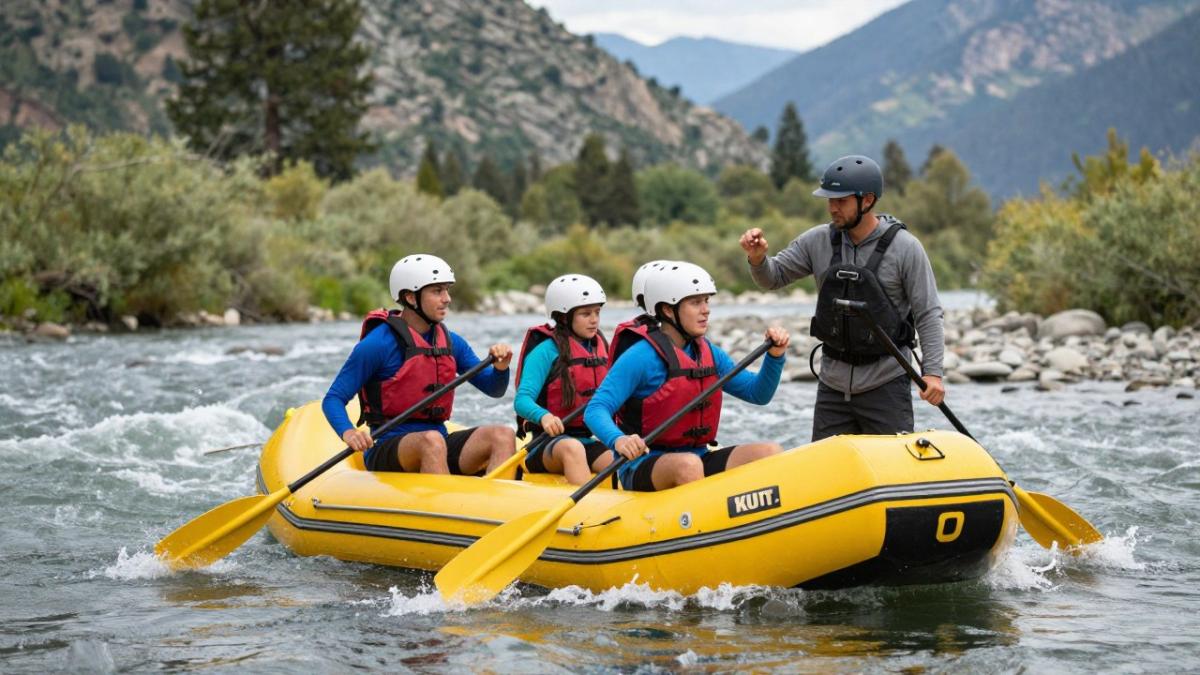
- Class III: moderate, irregular waves that require active paddling and a guide’s direction. You will get wet, the boat will move around, and the guide will call commands you need to follow. This is the upper end of what most first-timers should book.
The scale is not a precise, universal standard. Ratings are set by convention and can shift with water level, so the same rapid can feel like a different class at high flow.
For a first trip, treat Class III as a ceiling, not a target. If you want a deeper, river-specific breakdown of what each class actually feels like on Sierra rivers, see our guide to Tuolumne River rapid classes.
Watch out: a river marketed as “beginner-friendly” can still include a mandatory Class IV portage or a Class IV rapid at the end.
Best Time of Year for Whitewater Rafting
Late spring through early summer is the best window for most beginners, because snowmelt fills the rivers and outfitters run daily trips. In the Sierra, that usually means May through July, when flows are strong and the weather is warm.
Timing changes difficulty more than most people expect. Our month-by-month rafting season guide breaks down what each part of the year actually delivers.
What to Wear Whitewater Rafting
Wear quick-drying layers you do not mind soaking, secure footwear, and whatever thermal protection the outfitter recommends for the water temperature. Cotton is the one fabric to leave behind; it holds water and pulls heat from your body.
The essentials:
- Swimwear or quick-dry shorts and a synthetic top
- Secure sandals or water shoes that will not slip off
- A windproof layer for cool mornings
- Sunscreen and a strap for glasses
Cold water changes the list considerably, so read our cold-water rafting gear guide before an early-season or high-elevation trip.
Whitewater Rafting Safety Tips for Beginners
Listen to the safety briefing, keep your life jacket fastened, and paddle on command. Those three habits prevent most problems on beginner water.
Beyond the basics:
- Know your swimming comfort. You do not need to be a strong swimmer, but you should be calm in moving water.
- Respect age and health guidance. Ask outfitters about minimum ages and disclose medical conditions before booking.
- Learn the paddle commands before you launch: forward, back, and hold.
- Stay with the boat if you swim, and point your feet downstream.
Choosing Your First Rafting River Near Yosemite
Pick the river that matches your group’s least confident paddler, not its boldest.
Work through four questions in order. The first one that produces a firm answer usually settles the choice.
- What is your group’s floor? Identify the youngest age, the least confident swimmer, and anyone with a health restriction. Many outfitters set minimum ages around twelve for Class III water and lower for Class II. If your group includes a seven-year-old or a nervous grandparent, a Class II float is the honest answer, not a Class III run you hope they will enjoy.
- How much time and money do you have? A half-day guided trip is the lowest-commitment option and the easiest to fit around other plans. A full-day trip costs more and asks more of your group’s stamina. Multi-day trips add lodging, meals, and shuttle logistics. Compare what each price includes: raft, paddle, life jacket, helmet, guide, shuttle, and any meals. Extra costs commonly show up as parking, photos, wetsuit rental, and gratuities, so ask for the all-in figure before you book.
- What water do you want? Calm water and scenery points to a Class II float. Splashes without fear points to a guided Class III run. A mixed-ability group is best split by section, not by river, so stronger paddlers can take a harder stretch while others stay on the gentler one.
- When are you going? Season changes difficulty more than most people expect. Late spring and early summer bring snowmelt and stronger flows; late summer brings lower, rockier water that demands cleaner lines. Dam-controlled rivers hold steadier. If your dates are fixed, ask the outfitter how the current level compares to peak season before you commit.
A simple decision path:
- Want calm water and scenery? Choose a Class II float trip.
- Want splashes without fear? Choose a Class III run with a guide.
- Have a mixed group? Split by section, not by river.
- Traveling with kids twelve and up? Confirm the outfitter’s minimum age first.
If you are visiting Yosemite and want a guided option close to the park, our complete guide to rafting near Yosemite covers the local rivers in detail, and you can compare Yosemite rafting trips to see what fits your dates and group.
Sierra Mac runs guided trips on the Tuolumne, Merced, and Cherry Creek rivers, located 15 miles from Yosemite’s northwest entrance.
Watch out: booking by river name alone is the most common first-timer mistake.
Frequently Asked Questions
Are Class III rapids safe for beginners?
Class III rapids are the upper limit most outfitters allow for first-timers, and they are manageable when you book a guided trip. The water moves fast and waves can be a few feet high, but channels are usually clear of serious hazards. You need to be comfortable in moving water, able to follow paddle commands, and willing to swim a short distance if you fall out.
What should beginners wear for whitewater rafting?
Wear quick-drying synthetic layers, secure water shoes, and a swimsuit underneath. Avoid cotton, which stays wet and chills you, and leave loose jewelry and valuables behind. On colder spring flows, ask about wetsuits or splash jackets. Bring a strap for glasses, sunscreen for exposed skin, and a dry bag for a phone and car keys. Dress for the water temperature, not the air temperature.
What class of rapids is best for a first-time rafter?
Class II is the sweet spot for most first-timers: enough movement to feel like real whitewater, with straightforward lines and easy recovery if you swim. Class I float trips suit young children, older adults, and anyone who wants scenery over splash. A good rule is to start one class below what you think you can handle.
When is the best time of year for beginner whitewater rafting?
Late spring through early summer usually delivers the most reliable flows on mountain rivers, fed by snowmelt, though that also means colder water and stronger currents. Mid-summer into early fall brings warmer water, lower flows, and gentler rapids, which many beginners prefer. Ask your outfitter how water levels change the difficulty of the specific river section you are booking. A run that is Class III in June can soften to Class II by August, so the season you pick shapes the experience as much as the river.